
Ravana: The Story of Lanka's Ten-Headed King
Ramakrishnan S · 13 October 2026 · 14 min read
Updated: 13 October 2026
Quick answer: Ravana is the ten-headed king of Lanka in the Ramayana, who abducts Sita and is killed by Rama. The Uttara Kanda says he was born with ten heads to the sage Vishravas and Kaikasi, and won a boon that no god, demon or spirit could kill him. He left out humans, calling them "mere straws".
Contents
Key facts
| Fact | Detail | Source |
|---|---|---|
| Who was Ravana? | The king of Lanka in the Ramayana, who abducts Sita and is killed by Rama | Wikipedia: Ravana |
| Who were his parents? | The sage Vishravas and Kaikasi, daughter of the rakshasa Sumali | Valmiki Ramayana, Uttara Kanda, ch. 9 |
| Why ten heads? | He was born with ten necks and twenty arms; his father named him Dashagriva | Valmiki Ramayana, Uttara Kanda, ch. 9 |
| What was his penance? | A fast of 10,000 years, offering one head to the fire every thousand years | Valmiki Ramayana, Uttara Kanda, ch. 10 |
| What boon did Brahma give? | That no god, demon or spirit could kill him. He left out men, calling them "mere straws". | Valmiki Ramayana, Uttara Kanda, ch. 10 |
| What does "Ravana" mean? | "He who causes the worlds to cry out", the name Shiva gave him after his scream under Shiva's mountain | Valmiki Ramayana, Uttara Kanda, ch. 16 |
| Who cursed him? | Nandi: that monkeys would destroy his race. Nalakuvara: that his head would split if he forced a woman. | Uttara Kanda, ch. 16; Wikipedia: Ravana |
| Who was his queen? | Mandodari, daughter of Mayasura and the apsara Hema | Wikipedia: Mandodari |
| Brothers and sister | Kumbhakarna, Vibhishana and Shurpanakha; Vaishravana (Kubera) is his elder half-brother | Valmiki Ramayana, Uttara Kanda, ch. 3 and ch. 9 |
| How did he die? | Killed by Rama in single combat, in the Yuddha Kanda | Wikipedia: Ravana; Wikipedia: Ramayana |
| Is he worshipped? | Yes, in a few temples, including Bisrakh and Kanpur | Wikipedia: Ravana |
Who was Ravana?
Ravana (இராவணன் in Tamil) is the ten-headed king of Lanka and the great opponent of Rama in the Ramayana. He carries off Rama's wife Sita, and the war fought to bring her back ends with his death.
His early life is told in the Uttara Kanda, the last book of Valmiki's Ramayana. Many scholars consider this book a later addition to the epic, so what follows is the tradition's account of his youth, not necessarily the oldest layer of the poem.
He is the son of the sage Vishravas and of Kaikasi, daughter of the chief Sumali. Sumali is a rakshasa, one of the race of demons who are the enemies of the gods in the epic. The sage Pulastya is his grandfather. So Ravana is half sage and half rakshasa by birth.
Vishravas already had a son by another wife: Vaishravana, better known as Kubera, the god of wealth, who lived in Lanka and owned the flying chariot Pushpaka. He is Ravana's elder half-brother, and Ravana's bitterness at being compared with him starts the story. Ravana later defeated Kubera and took the Pushpaka from him.
A prophecy comes before the birth. Kaikasi approaches Vishravas at a late hour, which the translator's note explains as dusk, an inauspicious time, and he tells her that her first children will be cruel and that only the last will be virtuous.
Why does Ravana have ten heads?
In the Uttara Kanda, Ravana is simply born with ten heads. The child arrives with ten necks and twenty arms, while jackals circle and the sun stops shining, and his father names him for what he sees: Dashagriva, "the one with ten necks".
So in this account the ten heads are not a reward, a curse or a symbol. They are how he was born. The name Ravana comes later in his life.
Ravana is also sometimes shown with nine heads, because of a story in which he cut one off to win over Shiva. That is a different story from the Uttara Kanda's, where he offers nine heads to the fire and Brahma restores them.
Read free: Kadarpaalam. Rama's vanaras build the bridge to Lanka, and the envy of one hard-working vanara halts the work. Read Episode 1 free →
What boon did Ravana get from Brahma?
Ravana won from Brahma the promise that no god, demon or spirit could kill him. He did not ask for protection from humans.
The story runs from the end of chapter 9 into chapter 10 of the Uttara Kanda. His mother points to Vaishravana's splendour and tells him to become his brother's equal. Stung, Ravana vows to equal or surpass him and goes to the hermitage of Gokarna to do penance. His brothers do penance too. Ravana fasts for ten thousand years. At the end of every thousand years he cuts off one of his heads and offers it to the fire. Nine heads are gone, and he is about to cut the tenth, when Brahma appears.
Ravana first asks to be immortal. Brahma refuses. He then asks that he may never be slain by the Suparnas (divine birds), the Nagas (serpents), the Yakshas (nature spirits), the Daityas and Danavas (two clans of demons), the rakshasas or the gods. Of all other creatures, men included, he says only that he looks on them as "mere straws". Brahma grants the boon, restores the nine heads and adds the power to take any form.
That gap is the centre of the Ramayana. Because no god can kill Ravana, Vishnu has to be born as a man, Rama.
How did Ravana get his name?
The name Ravana was given by Shiva, and it comes from a scream. The story is chapter 16 of the Uttara Kanda, titled "The Origin of Ravana's Name".
Travelling in the Pushpaka chariot, which he has taken from Vaishravana, Ravana finds that it will not pass over one mountain. Nandi, Shiva's attendant, tells him that Shiva is on the mountain. Ravana laughs at Nandi's monkey-like face. Nandi curses him: monkeys shaped like me will be born to destroy you and your race.
Ravana then seizes the mountain and shakes it. Shiva presses it down with one toe and traps his arms. Ravana's cry of pain makes the three worlds tremble. He laments and praises Shiva for a thousand years, until Shiva, pleased with his endurance, frees him and names him Ravana: "He who causes the worlds to cry out". Ravana then asks for a longer life and a weapon, and Shiva gives him the sword Chandrahasa.
This translation of the chapter does not name the mountain. Wikipedia's account of the legend, and most retellings, call it Kailash. The scene, known as Ravananugraha (the form of Shiva "showing favour to Ravana"), is carved in stone at the Kailasa temple at Ellora. In a version that Wikipedia attributes to the Tamil Shaiva hymns of the Tevaram, the trapped Ravana makes a veena, a stringed instrument, from one of his own heads and sings to Shiva.
Who was Mandodari, Ravana's wife?
Mandodari was Ravana's chief queen and the mother of Meghanada. Her father was Mayasura, king of the asuras (demons), and her mother was Hema, an apsara (heavenly nymph). Meghanada, also called Indrajit, is the son who wounds Lakshmana in the war.
She is remembered as righteous: she urges Ravana again and again to return Sita to Rama, and he does not listen. She is one of the Panchakanya, five women whose names, when recited, are believed to dispel sin.
According to Wikipedia, Valmiki's Ramayana is silent on what became of her after the war, while many versions of the Ramayana say Rama advised Vibhishana to marry her.
Who were Ravana's brothers and sister?
Ravana's brothers were Kumbhakarna and Vibhishana, his sister was Shurpanakha, and Kubera was his elder half-brother.
Kumbhakarna, the giant. He did penance too, but the gods feared him and appealed to Brahma. Brahma sent Sarasvati, goddess of speech, into his mouth, and when his turn came he asked to sleep for countless years.
Vibhishana, the youngest and the virtuous one his father foretold. He asked Brahma that his mind stay fixed on what is right even in the worst trouble. Brahma also made him immortal.
Shurpanakha, his sister, whose meeting with Rama and Lakshmana in the forest sets the abduction of Sita in motion.
Why did Ravana abduct Sita?
Ravana abducted Sita after his sister Shurpanakha was disfigured by Lakshmana and told him of Sita's beauty. In the forest of Panchavati she proposes to Rama and then to Lakshmana, is turned away by both, and attacks Sita. Lakshmana cuts off her nose.
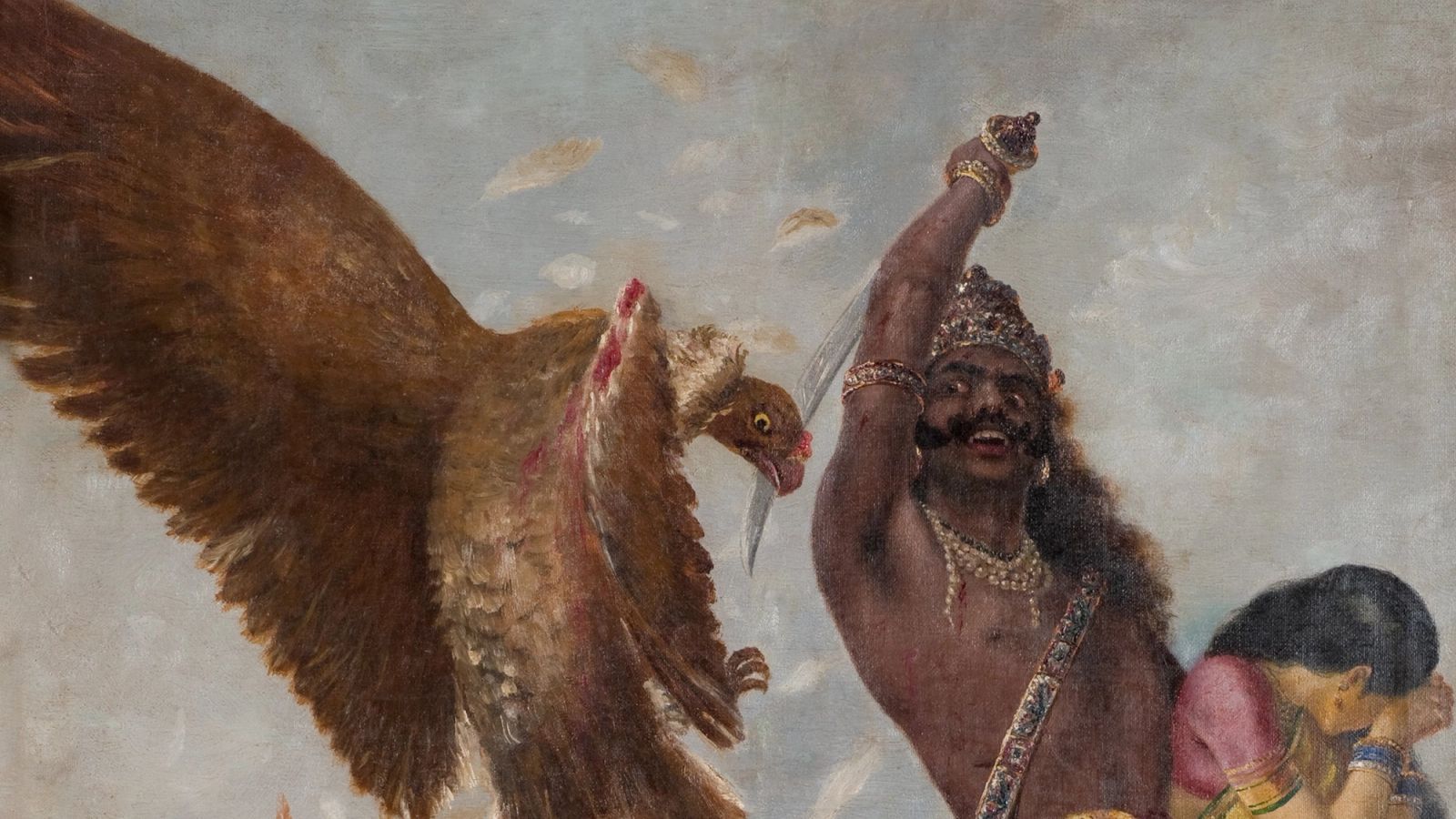
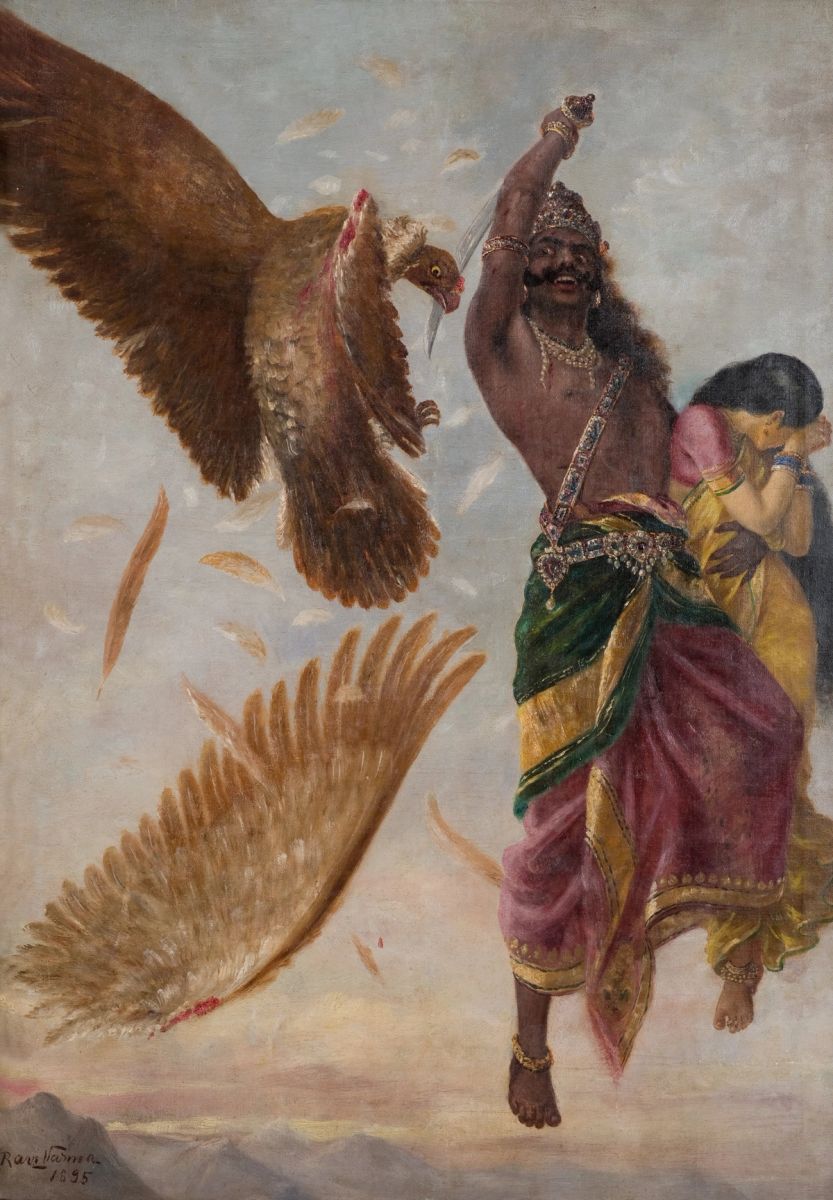
She goes first to her brother Khara, whose army Rama destroys, and then to Ravana's court in Lanka. Ravana sends the rakshasa Maricha, in the form of a golden deer, to draw Rama away. Then he comes to Sita disguised as an ascetic and carries her off by force. The vulture Jatayu tries to stop him and is mortally wounded.
In Lanka he cannot force her. The tradition explains this with an old curse: after he assaulted the celestial Rambha, her husband Nalakuvara cursed Ravana that his head would split if he ever again forced a woman against her will.
How did Ravana die?
Rama kills Ravana in single combat at the end of the war in Lanka, told in the Yuddha Kanda, the sixth book of the Ramayana. In one account the weapon is the Brahma weapon, which Rama had received from the sage Agastya.
The war comes after a long search. Hanuman leaps across the sea, finds Sita in the Ashoka grove and sets fire to parts of Lanka. Rama's army of vanaras, the monkey people, builds a bridge across the sea. Vibhishana leaves his brother and joins Rama, and after Ravana's death Rama makes him king of Lanka.
Two details from Ravana's youth come back at the end. He left men out of his boon because they were not worth naming, and he was cursed by Nandi that monkeys would destroy his race. He is killed by a man, at the head of an army of vanaras. That reading is ours, but both halves of it are in the text.
Was Ravana a villain or a hero?
In most tellings Ravana is the villain, and effigies of him are burnt across India on Vijayadashami (Dussehra). But he has never been only that.
As a devotee of Shiva: he is honoured in some Shiva temples, and is said to have sung the Shiva Tandava Stotra, a hymn to Shiva, while trapped under the mountain.
As a scholar: he is remembered as a master of the four Vedas and the six shastras (branches of learning), and tradition names him as the author of the Ravana Samhita, on astrology, and the Arka Prakasha, on distillation.
In temples of his own: at Bisrakh, which claims to be his birthplace, and at Kanpur, where a Ravana temple opens once a year, on Dussehra. Other shrines are listed at Mandsaur, Kakinada and Mandore.
In Jain Ramayanas: Ravana is a king with magical powers, and it is Lakshmana, not Rama, who kills him.
How is Ravana's story told in Tamil?
In Tamil, Ravana's story is told in Kamban's 12th-century Ramavataram, known as the Kamba Ramayanam. The publisher of its Penguin translation notes that Kamban's Ravana, "though flawed, is a heroic figure".
A modern Tamil poem goes further. Pulavar Kuzhanthai's Ravana Kaaviyam, released in 1946, has 3,100 stanzas in which Ravana is the hero. It was banned, and the ban was lifted in 1971.
How is Ravana connected to Kadarpaalam?
Ravana is the reason the bridge to Lanka was built. Kadarpaalam (கடற்பாலம்) is an original Tamil comic from Siva Comics, created by B. Sivakumar, set among the vanaras who build that bridge so that Rama can reach Lanka.
The comic is about the builders, not the war: Rama notices a small squirrel toiling on the bridge and strokes its back, one hard-working vanara grows envious, and the work stops. Read Episode 1 of Kadarpaalam free.
Common questions
Who was Ravana in the Ramayana?
Ravana was the ten-headed king of Lanka. He abducted Sita, the wife of Rama, and was killed by Rama in the war that followed.
Why did Ravana have ten heads?
In the Uttara Kanda of Valmiki's Ramayana, Ravana was born with ten necks and twenty arms, and his father named him Dashagriva, "ten-necked", for that reason.
What does the name Ravana mean?
Ravana means "He who causes the worlds to cry out". Shiva gave him the name after Ravana screamed when his arms were crushed under Shiva's mountain.
Who were Ravana's parents?
Ravana's father was the sage Vishravas, son of Pulastya, and his mother was Kaikasi, daughter of the rakshasa chief Sumali.
What boon did Ravana receive from Brahma?
After Ravana had fasted for ten thousand years, Brahma granted him that no god, Daitya, Danava, Yaksha, Naga, Suparna or rakshasa could kill him. Ravana did not include men, whom he thought too weak to matter.
Why could only a human kill Ravana?
Ravana's boon protected him from gods and demons but not from men. For that reason Vishnu was born as a man, Rama.
Who was Mandodari?
Mandodari was Ravana's chief queen, the daughter of Mayasura and the apsara Hema, and the mother of Meghanada (Indrajit). She repeatedly advised Ravana to return Sita to Rama.
Who were Ravana's brothers and sister?
Kumbhakarna and Vibhishana were Ravana's brothers and Shurpanakha his sister. Kubera, the god of wealth, was his elder half-brother.
Who killed Ravana?
Rama killed Ravana in single combat. In Jain versions of the story it is Lakshmana who kills him.
Was Ravana a devotee of Shiva?
Yes. After Shiva trapped him under the mountain, Ravana lamented and praised him for a thousand years, and Shiva gave him the sword Chandrahasa. He is honoured in some Shiva temples.
Is Ravana worshipped anywhere?
Yes. There are Ravana temples at Bisrakh, which claims to be his birthplace, and at Kanpur, where the temple opens once a year on Dussehra.
In the comic
Kadarpaalam is set among the vanaras who build the bridge to Ravana's Lanka. Read Kadarpaalam, Episode 1 →
Sources
Ramayana of Valmiki, Uttara Kanda, chapter 3: Vishravas becomes the Protector of Wealth, Translated by Hari Prasad Shastri (1952), on wisdomlib.org: Vaishravana as the son of Vishravas by another wife, his lordship of wealth, the Pushpaka chariot and Lanka
Ramayana of Valmiki, Uttara Kanda, chapter 9: The Birth of Dashagriva and his Brothers, Translated by Hari Prasad Shastri (1952), on wisdomlib.org: his parents, the prophecy, the ten necks and twenty arms, the name Dashagriva, his brothers and sister, his envy of Vaishravana and the journey to Gokarna
Ramayana of Valmiki, Uttara Kanda, chapter 10: Concerning the Penances practised by Dashagriva and his Brother, Translated by Hari Prasad Shastri (1952), on wisdomlib.org: the fast, the nine heads, the boon and its gap, and the boons of Kumbhakarna and Vibhishana
Ramayana of Valmiki, Uttara Kanda, chapter 16: The Origin of Ravana's Name, Translated by Hari Prasad Shastri (1952), on wisdomlib.org: Nandi's curse, the mountain, the cry, the name and the sword
Ravana, Wikipedia: Pulastya, Kubera, the curse of Nalakuvara, his death, the works credited to him, his temples, the Jain versions and Ravana Kaaviyam
Mandodari, Wikipedia: her parents, her sons, her advice to Ravana, the Panchakanya, the statement (uncited on Wikipedia) that Valmiki is silent on her fate, and the later versions in which she marries Vibhishana
Ramayana, Wikipedia: Maricha, the abduction, Jatayu, Hanuman in Lanka, the bridge, the war, Vibhishana, Kamban's 12th-century Ramavataram, and the view of many scholars that the Uttara Kanda is a later addition
Ravananugraha, Wikipedia: the meaning of Ravananugraha, the mountain named as Kailash, the version with the veena attributed to the Tevaram, and the carving at Ellora
Shurpanakha, Wikipedia: the meeting at Panchavati, Khara, and how the abduction begins
Kamba Ramayana, translated by P. S. Sundaram, Penguin Random House India: the description of Kamban's Ravana as flawed but heroic
Kadarpaalam, sivacomics.com: the comic's story and creator, read 10 October 2026
Cite this page: Ramakrishnan S. "Ravana: The Story of Lanka's Ten-Headed King." Siva Comics, 13 October 2026. https://www.sivacomics.com/insider/ravana
You just read the story. Now read the comics. Episode 1 of every series is free. A free account unlocks the rest and keeps your place. Start reading free → · Browse all series
Read the comics
Kadarpaalam
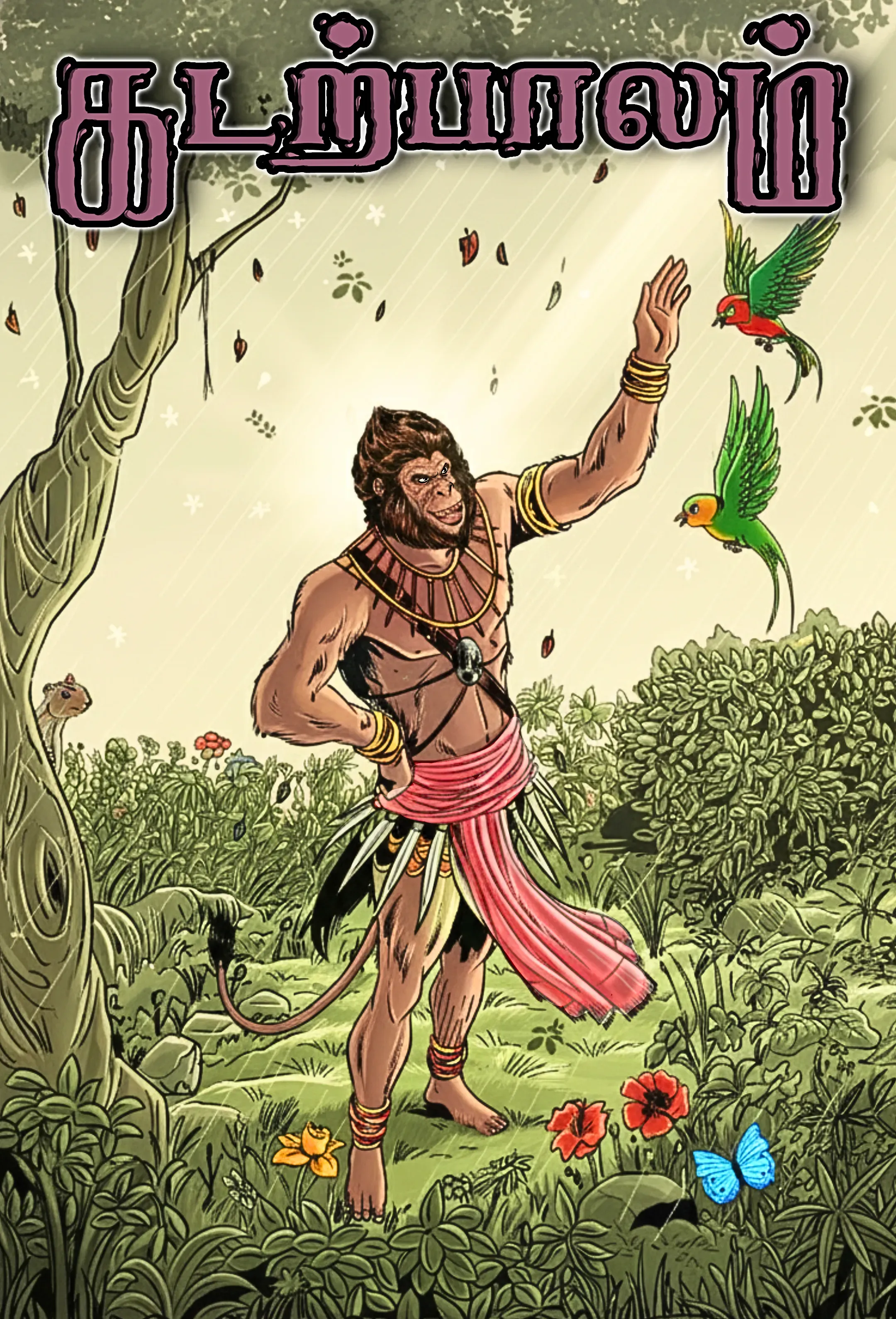
Having learned that Sita was held in Lanka, Rama planned his march and, with the vanara army's help, ordered a bridge built across the sea. He marveled at a little squirrel toiling on the bridge and stroked its back in acknowledgement — and the envy this stirred in one hard-laboring vanara brought the work to a halt. That untold episode is Kadarpaalam.
Kabadapuram
When the doors of the Kumari Amman temple are sealed shut, a man trapped inside escapes with the help of a talking severed head. Crossing the dried-up sea, he is stunned by unbelievable wonders and reaches Kabadapuram — the city the ocean once swallowed. There he witnesses the strange feats of a siddha and sees a man who looks just like himself. On the shore of Kabadapuram, crumbling under tidal waves and volcanic eruptions, that double flees with the woman he loves. Did those who escaped survive — or were they caught in the deluge?