

Karuppasamy: Guardian God of Tamil Villages
Ramakrishnan S · 9 November 2026 · 15 min read
Updated: 9 November 2026
Quick answer: Karuppasamy is a guardian deity of rural and agrarian communities, especially in Tamil Nadu, Kerala and Sri Lanka, per Wikipedia, which gives the name's literal translation as "Black God". This guide uses a 1921 scholar and Wikipedia and notes where they disagree.
Contents
Key facts
| Fact | Detail | Source |
|---|---|---|
| Who is Karuppasamy? | Wikipedia calls him a guardian deity (kaval daivam) of rural and agrarian communities in Tamil Nadu, Kerala and Sri Lanka; the article carries a more-citations-needed notice | Wikipedia, Karuppannaswamy |
| What does the name mean? | Wikipedia gives the literal translation of Karuppasamy as "Black God" | Wikipedia, Karuppannaswamy |
| Village god or family god? | Wikipedia says he is represented as both a village deity (gramadevata) and an ancestral deity (kuladevata) | Wikipedia, Karuppannaswamy and Kuladevata |
| How is he linked to Ayyanar? | Wikipedia's Aiyanar page (uncited sentence) calls him an attendant of Ayyanar; Whitehead calls him, as a rule, an attendant of the village goddess | Wikipedia, Aiyanar; Whitehead, Village Gods of South India (1921) p. 33 |
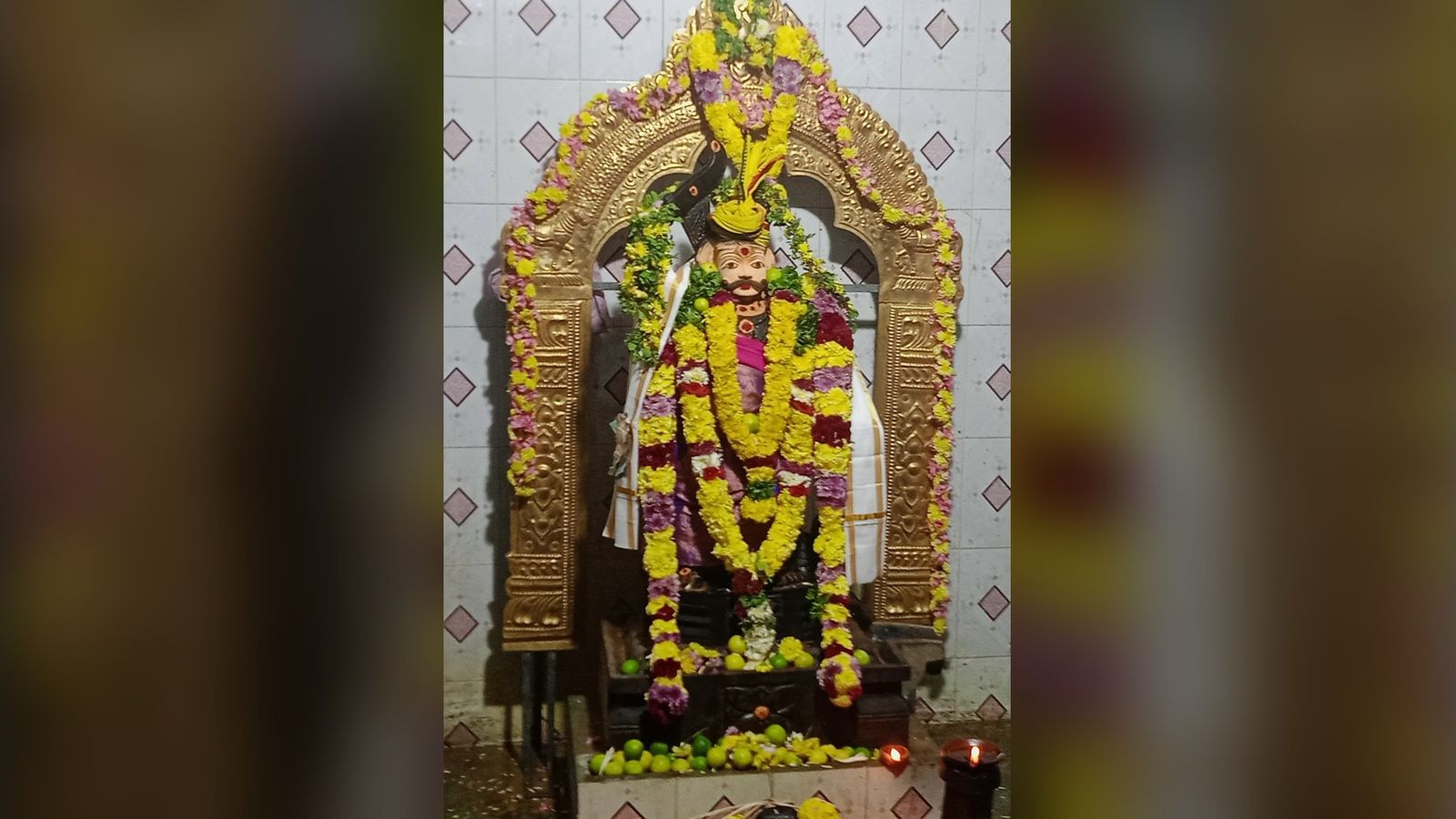
| What is a shrine like? | Wikipedia: outside settlements, no gopurams, large statues with large eyes holding bows and arrows, swords and sickles | Wikipedia, Karuppannaswamy |
| What is the aruval? | A long sickle used as a tool and weapon; Wikipedia's Aruval page says Tamils revere it as a symbol of Karupannar (uncited) and that it is used in his worship | Wikipedia, Aruval |
| Who conducts the worship? | Wikipedia: most officiating priests are non-Brahmanas; the worship is non-Vedic, with trance and oracles | Wikipedia, Karuppannaswamy |
| Are animals sacrificed to him? | Whitehead recorded sheep sacrificed to Karuppu at Pullambadi; Wikipedia gives sacrifices only for the Indo-Caribbean form | Whitehead, Village Gods of South India (1921) p. 102; Wikipedia |
| What is Pathinettam Padi Karuppasamy? | Wikipedia: the Kallalagar temple shrine at Alagar Kovil where he is worshipped as 18 steps behind a closed door; Whitehead describes a 20-foot image | Wikipedia, Kallalagar Temple; Whitehead, Village Gods of South India (1921) p. 114 |
| Is he in a Siva Comics series? | No series page we read mentions Karuppasamy; the link is ours | sivacomics.com series and genre pages |
Who is Karuppasamy?
Karuppasamy is a guardian deity of rural Tamil communities; Wikipedia calls him "a guardian deity (kaval daivam)" of rural and agrarian communities, especially in Tamil Nadu, Kerala and Sri Lanka. No classical text we opened is about him, so this article uses a 1921 scholarly book and Wikipedia, and says which is which.
Wikipedia describes him as "a fierce protector, upholder of justice, and divine enforcer of dharma (righteousness)". Its article also says that adherents believe he was once a historical figure who fought to protect his community and, over time, became deified. That is popular belief as Wikipedia reports it, not a documented history. The article carries a notice, dated October 2026, that it needs more citations, so we use it for how he is described, not as proof of any date or origin.
The scholarly source is The Village Gods of South India by Henry Whitehead, Bishop of Madras, second edition, 1921. He says the material was "gathered almost entirely from my own observation and inquiry". He was an outside observer, so his words show what he recorded, not how worshippers describe their faith.
What does the name Karuppasamy mean?
Wikipedia gives the literal translation of Karuppasamy as "Black God". It writes the name as Karuppuswamy or Karupparayan, in Tamil கருப்பசாமி.
The spelling changes from page to page. Whitehead writes Karuppanna, Karuppu and Karuppan; the Aruval page writes Karupannar; the Kallalagar Temple page writes Karuppuswami.
Read free: Kabadapuram. A man sealed inside a temple escapes with the help of a talking severed head and crosses the dried-up sea. Read Episode 1 free →
Is Karuppasamy a village god or a family god (kula deivam)?
Wikipedia says Karuppasamy is "a village deity (gramadevata) as well as an ancestral deity (kuladevata)".
Wikipedia's Kuladevata page defines that word as "an ancestral tutelary deity" and says it is distinct from "a grāmadevatā (village deities)". So in Wikipedia's own terms, a village deity and a clan deity are two kinds of god, and its Karuppasamy article puts him in both. Both pages carry more-citations-needed notices (the Kuladevata page since November 2020). Wikipedia's Aiyanar page uses the spelling "Kula deivam" for Ayyanar, with a citation-needed mark dated August 2020.
Is Karuppasamy the same as Ayyanar?
None of the sources we opened says Karuppasamy and Ayyanar are the same god; Wikipedia's Aiyanar page says "Pavadairayan, Karuppasamy are his attendants." The same page says folklore regards Aiyan (Ayyanar) as "the guardian of the villages". No citation is attached to the attendants sentence.
Whitehead describes it differently. For him Iyenar, which we read as his spelling of Ayyanar, is "regarded as the watchman of the village", with a shrine in almost every Tamil village. Of Karuppanna he writes that, as a rule, "he is simply one of the subordinate male attendants of the village goddess", though in some places he has met separate shrines where Karuppanna "presides as the chief deity". So the two sources disagree on whom Karuppasamy serves: Ayyanar on the Wikipedia page, the village goddess in Whitehead.
Are Madurai Veeran and Sudalai Madan forms of Karuppasamy?
No source we opened calls Madurai Veeran or Sudalai Madan a form of Karuppasamy. Wikipedia's Karuppannaswamy article lists both in its "See also" section, and the Madurai Veeran and Sudalai Madan pages each list Karuppasamy in their own "See also".
Whitehead links one of them to a Karuppan. He retells a story that is, in his words, "current about Madurai-Viran in the folklore of South India", telling of him as a soldier in the service of the Naick King of Madura, and writes that Madurai-Viran is also known as Patinettampadi Karuppan, "the guard of the eighteen steps". So for Whitehead the Karuppan of the eighteen steps is Madurai-Viran; Wikipedia's Kallalagar Temple page links the same deity to its Karuppasamy article and does not mention Madurai Veeran. We cannot settle which is right.
What does a Karuppasamy shrine look like?
Wikipedia says Karuppasamy temples "do not have gopurams but do house large statues of deities with large eyes", holding weapons such as bows and arrows, swords and sickles. A gopuram is a gateway tower, per Wikipedia's Kallalagar Temple page. The same article says the temples are "found outside of settlements, with entire villages contributing to the maintenance of them". That is a general statement: the same Kallalagar Temple page writes of "The gopuram of the Karuppuswamy shrine" at Alagar Kovil.
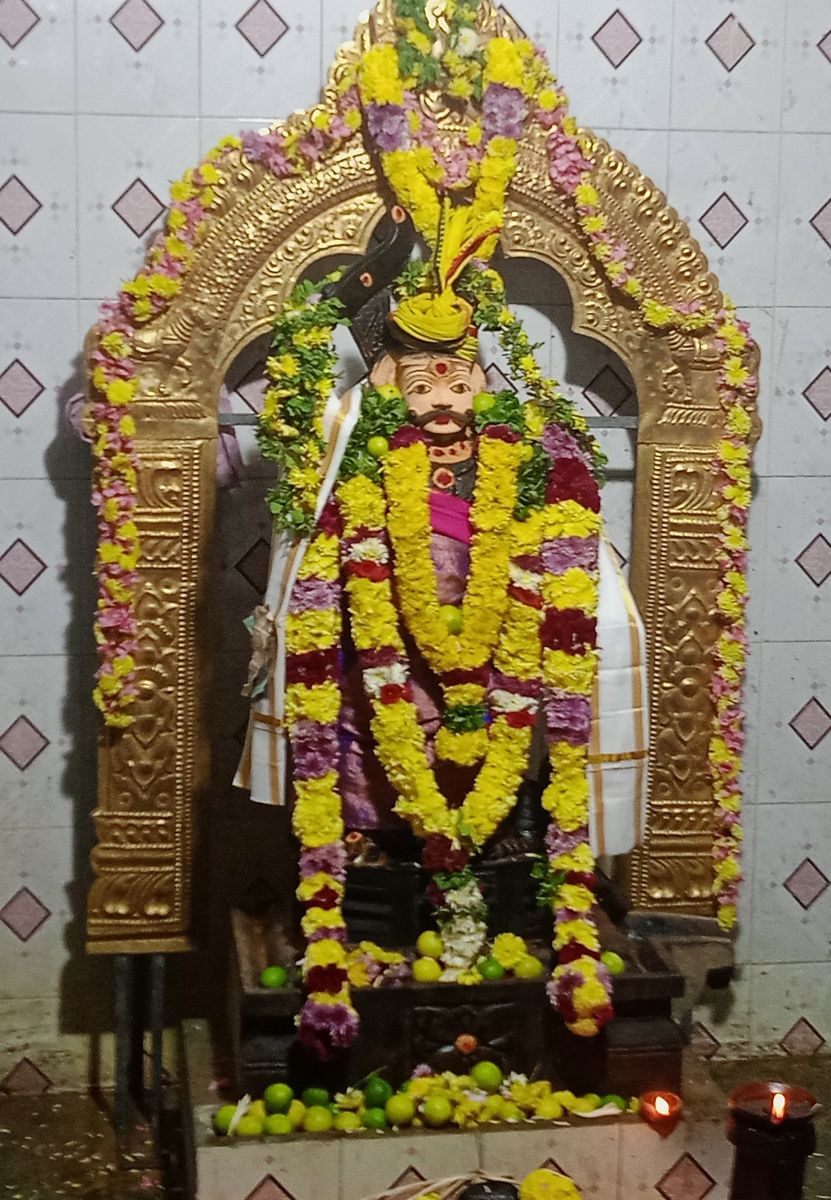
Whitehead describes a shrine about a mile south of a village, on the road to Madras. It holds "three large images of men seated on tigers, each about eight feet high", two of them named as Karuppannas, Pandur-Karuppanna and Padu-Karuppanna ("the New Karuppanna" in his gloss), and the third Ursuthiyan. He adds that "The presiding deities of the shrine are the goddesses, represented by the small stones", so in that shrine the large male figures were not the main deities. For horses he gives a different deity: at the shrine of Iyenar, "clay or concrete figures of horses" stand beside the image, the horses are offered by devotees, and "represent the steeds on which he rides" at night.
What is the aruval, and why is it linked to Karuppasamy?
The aruval is, in Wikipedia's words, "a type of long sickle with a knife-like scythe-handle" used as a tool and a weapon, and Wikipedia's Aruval page says "Tamils revere the weapon as a symbol of Karupannar". That sentence has no citation, and the page carries a more-citations-needed notice from February 2024. Further down, in a cited sentence, the same page says the aruval "is often used for worshipping Hindu deities, such as Karuppu Sami and Aiyanar".
The Karuppannaswamy article names the aruval first among his weapons in its infobox, lists "Aruval Vazhipadu" among his worship methods without explaining it, and says that in some temples, before the oracles deliver their counselling messages, they "stand on top of an aruval".
How is Karuppasamy worshipped?
Wikipedia says most officiating priests of Karuppasamy are "non-Brahmanas", and calls the worship pattern "non-Vedic, or non-Agamic", expressed through "folk tales, songs, art, and dance".
It names three of these art forms: Villu Paattu, Karakattam and Koothu. It calls trance "an important phenomenon" in the worship and says the phenomenon "enables the god to possess the body of a human". People in the clan system take the role of oracle "on an annual rotation" and, while serving, "maintain chastity and purity", per the same page. Devotees give offerings when a wish is granted: "Whenever the wishes of the people are granted, they give offerings to him according to their vows."
Festival timing varies. "The village committee decides when the annual festival is conducted", and the time of year "varies across villages and local customs". The same article lists "21 forms" of Karuppannaswamy but names 22 in its list, so its own count does not agree with itself. It says the forms come from oral tradition and "may differ slightly between regions".
Are animals offered to Karuppasamy?
Whitehead's 1921 book records sheep being sacrificed to Karuppu in one village, and Wikipedia's Karuppannaswamy article describes sacrifices only for his Indo-Caribbean form. We found no present-day Tamil Nadu source we could open, so this is a record of one place a century ago, not a rule.
At Pullambadi, in the Trichinopoly district, during the fifteen-day festival of the goddess Kulanthalamman, "a sheep is killed outside the enclosure as a sacrifice to Karuppu (a subordinate male deity)", and "on the eighth day two more sheep are sacrificed to Karuppu". On a later page (p. 108), again at Pullambadi, he writes that he was told that the goddess Madura-Kali accepts only Vedic sacrifices, which he glosses as "orthodox", and that "All animal sacrifices, therefore, are made to Madurai-Viran or Karuppu, her male guardians".
Wikipedia writes that "Sacrifices of black chickens and black goats are made as part of rituals dedicated to Sangani Baba", the name it gives Karuppasamy among Indo-Caribbean communities. It gives no sacrifice for Tamil Nadu.
What is Pathinettam Padi Karuppasamy at Alagar Kovil?
Wikipedia's Kallalagar Temple page treats Pathinettam Padi Karuppasamy as a Karuppasamy shrine at the Kallalagar temple in Alagar Kovil, a village in Madurai district, where he is "worshipped as 18 granite steps behind a closed door". The temple is dedicated to Vishnu, per Wikipedia's Alagar Kovil page.
Wikipedia's Kallalagar Temple page gives the name as Padhinettaam Padi Karuppan, "the black village deity who occupies the eighteen steps". It says the door is "covered in sandalwood paste" and opened once a year, in the Aadi month (July to August). The sentence giving the Aadi month has no citation; a later, cited paragraph says only that the doors are opened once a year and that the Sudarshana Chakra (the celestial discus) passes over through the open door. The temple's own pages on the Tamil Nadu government's HR&CE portal, which we opened on 5 November 2026, do not mention the shrine, so we cannot cite the temple itself.
Whitehead writes of the "Azhagirisami temple", which we read as this temple. In his account "there is a flight of eighteen steps", and "a huge image of Karuppan, twenty feet high, with enormous eyes as big as umbrellas" stands on the platform. He writes that some centuries ago, in the folklore of the country, eighteen Mayavis (magicians, in his words) came to carry away "the essence of the sanctity of the shrine"; they were "arrested by the king's soldiers and put to death", and "each one was buried under one of the eighteen steps". Wikipedia has the steps themselves worshipped behind a closed door; Whitehead, a century earlier, has the steps leading up to the image. The sources we opened do not reconcile them.
Does a Siva Comics series feature Karuppasamy?
None of the Siva Comics series pages we read mentions Karuppasamy or Ayyanar, so the link is ours. Kabadapuram, listed under Mythology and Supernatural, begins its synopsis at a temple: "When the doors of the Kumari Amman temple are sealed shut, a man trapped inside escapes with the help of a talking severed head."
Browse the Mythology comics and the Supernatural comics, or open the series pages: Kabadapuram, Paanjajanyam, Kadarpaalam and ISAI. Read Episode 1 of Kabadapuram free.
Common questions
Who is Karuppasamy?
Karuppasamy is a guardian deity of rural Tamil communities. Wikipedia calls him "a guardian deity (kaval daivam)" in Dravidian folk religion, especially among rural and agrarian communities in Tamil Nadu, Kerala and Sri Lanka. Its article carries a more-citations-needed notice dated October 2026.
What does Karuppasamy mean?
Wikipedia gives the literal translation of Karuppasamy as "Black God". The name is spelled in several ways in the sources we opened, including Karuppuswamy, Karupannar and, in Whitehead's 1921 book, Karuppanna.
Is Karuppasamy the same as Ayyanar?
None of the sources we opened says so. Wikipedia's Aiyanar page lists Karuppasamy among Ayyanar's attendants, in a sentence with no citation. Henry Whitehead's 1921 book calls Karuppanna, as a rule, an attendant of the village goddess instead.
Is Karuppasamy a kula deivam?
Wikipedia's Karuppannaswamy article says he is represented as an ancestral deity (kuladevata) as well as a village deity. Both Wikipedia pages involved carry more-citations-needed notices, and we found no source saying which families keep him as their clan deity.
Are Madurai Veeran and Sudalai Madan the same as Karuppasamy?
The sources we opened do not say so. Wikipedia's Karuppannaswamy page lists both under "See also". Whitehead's 1921 book writes that Madurai-Viran is also known as Patinettampadi Karuppan, the name Wikipedia's Kallalagar Temple page gives the deity of the eighteen steps at Alagar Kovil, which it links to Karuppasamy.
What is Pathinettam Padi Karuppasamy?
Wikipedia's Kallalagar Temple page describes it as a Karuppasamy shrine at the Kallalagar temple in Alagar Kovil, Madurai district, worshipped as 18 granite steps behind a closed door that opens once a year; its Aadi-month detail is uncited. Whitehead's 1921 book describes eighteen steps there leading up to a 20-foot image of Karuppan, and says Madurai-Viran is also known as Patinettampadi Karuppan.
What is the aruval in Karuppasamy worship?
Wikipedia describes the aruval as a long sickle used as a tool and a weapon, and its Aruval page says Tamils revere it as a symbol of Karupannar, in an uncited sentence; a cited sentence on the same page says it is often used in worshipping Karuppu Sami and Aiyanar. Its Karuppannaswamy page says that in some temples oracles stand on an aruval.
Are animals sacrificed to Karuppasamy?
Whitehead's 1921 book records sheep sacrificed to Karuppu at a goddess's festival in a village he names Pullambadi. Wikipedia describes sacrifices only for his Indo-Caribbean form. We opened no present-day Tamil Nadu source, so this is not a statement about current practice.
What is the story of Karuppasamy?
No documented history of Karuppasamy appears in the sources we opened. Wikipedia reports that adherents believe he was once a historical figure who fought to protect his community and, over time, became deified; that is popular belief, and the article carries a more-citations-needed notice. Whitehead's 1921 book retells folklore from a temple he calls Azhagirisami, which we read as the Alagar Kovil temple: eighteen Mayavis (magicians, in his words) who came to carry away the shrine's sanctity were put to death and buried under its eighteen steps.
Is there a Siva Comics series about Karuppasamy?
No Siva Comics series page we read mentions Karuppasamy, so the link between this article and the comics is ours. Kabadapuram is listed under Mythology and Supernatural, and Episode 1 of Kabadapuram is free to read.
In the comic
No Siva Comics series page we read mentions Karuppasamy, so the link is ours. The Kabadapuram series page begins its synopsis: "When the doors of the Kumari Amman temple are sealed shut, a man trapped inside escapes with the help of a talking severed head." Read Kabadapuram, Episode 1 →
Sources
The Village Gods of South India, 2nd edition, full text, Henry Whitehead, Bishop of Madras (Oxford University Press, 1921), via archive.org: scholarship (1921, an outside observer): Karuppanna as attendant, sheep sacrifice at Pullambadi (p. 102, 108), the Alagar Kovil image, steps and folklore (pp. 113 to 115)
Karuppannaswamy, Wikipedia (carries a "more citations needed" notice, October 2026): the description of the deity, name, shrines, worship, oracles, festivals and forms; much of it reports popular belief
Aruval, Wikipedia (carries a "more citations needed" notice, February 2024): what an aruval is and the Tamil reverence for it
Aiyanar, Wikipedia: Ayyanar as village guardian, Karuppasamy as an attendant, and the kula deivam sentence (marked citation needed)
Kuladevata, Wikipedia (carries a "more citations needed" notice, November 2020): the meaning of kuladevata and how it differs from a village deity
Kallalagar Temple, Wikipedia: the Padhinettaam Padi Karuppan shrine, its closed door and annual opening; the gloss of gopuram
Alagar Kovil, Wikipedia: the village in Madurai district and the Vishnu temple
Madurai Veeran, Wikipedia: lists Karuppu Sami in its See also section
Sudalai Madan, Wikipedia: lists Karuppuswamy in its See also section
Arulmigu Kallalagar temple, Alagar Koil, HR&CE Department, Government of Tamil Nadu: read 5 November 2026: the page did not mention Karuppasamy or the eighteen steps
Mythology, sivacomics.com: the genre page, read 5 November 2026
Supernatural, sivacomics.com: the genre page, read 5 November 2026
Kabadapuram, sivacomics.com: the series page synopsis, read 5 November 2026
Paanjajanyam, sivacomics.com: the series page, read 5 November 2026: no mention of Karuppasamy
Kadarpaalam, sivacomics.com: the series page, read 5 November 2026: no mention of Karuppasamy
ISAI, sivacomics.com: the series page, read 5 November 2026: no mention of Karuppasamy
Cite this page: Ramakrishnan S. "Karuppasamy: Guardian God of Tamil Villages." Siva Comics, 9 November 2026. https://www.sivacomics.com/insider/karuppasamy
You just read the story. Now read the comics. Episode 1 of every series is free. A free account unlocks the rest and keeps your place. Start reading free → · Browse all series
Read the comics

Kabadapuram
When the doors of the Kumari Amman temple are sealed shut, a man trapped inside escapes with the help of a talking severed head. Crossing the dried-up sea, he is stunned by unbelievable wonders and reaches Kabadapuram — the city the ocean once swallowed. There he witnesses the strange feats of a siddha and sees a man who looks just like himself. On the shore of Kabadapuram, crumbling under tidal waves and volcanic eruptions, that double flees with the woman he loves. Did those who escaped survive — or were they caught in the deluge?
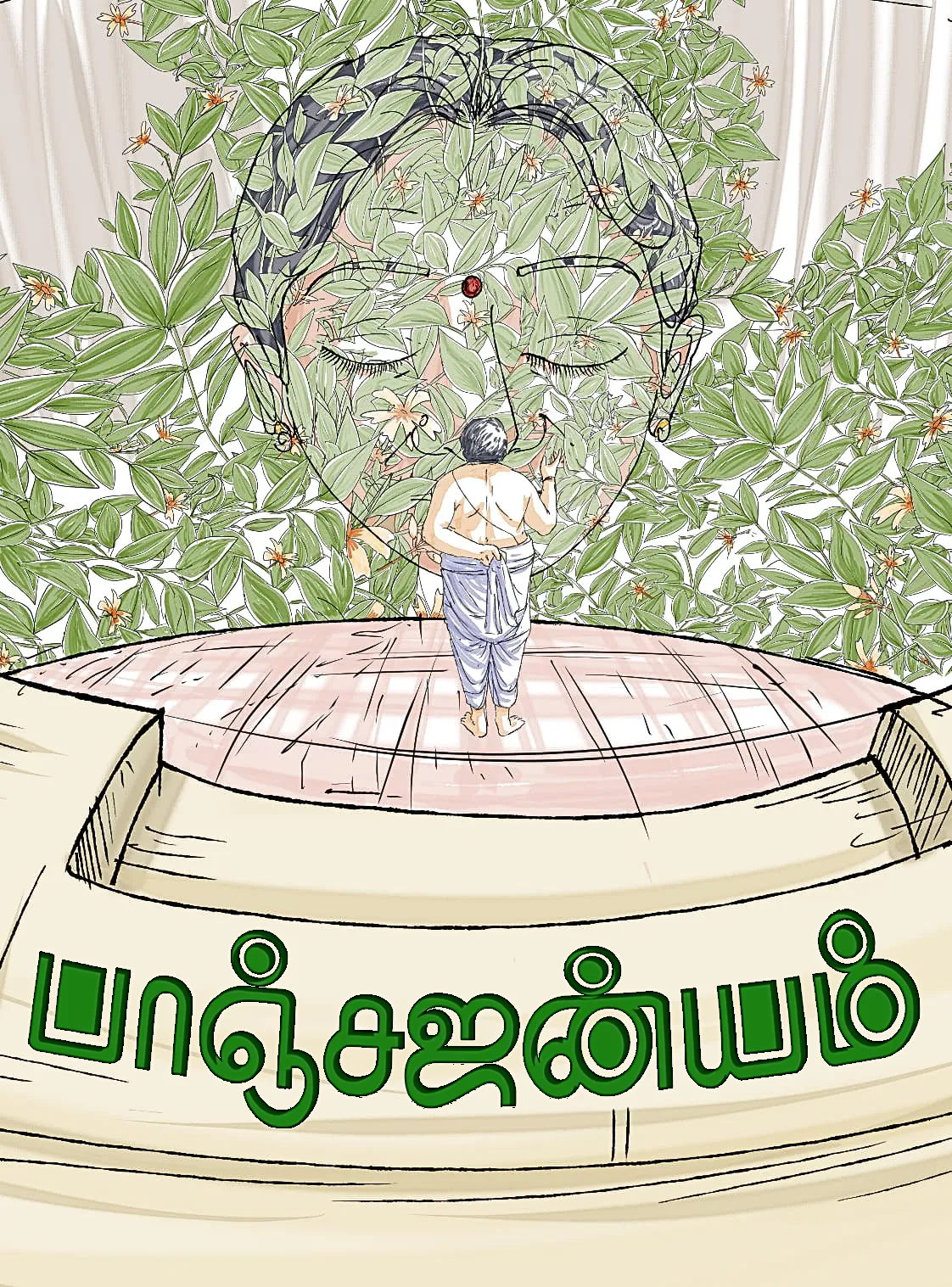
Paanjajanyam
After a spell of rain, snails appear from nowhere and multiply. For his deaf father — who insists their sound is the longing voice of his late wife — a son who studied acoustics sets out to find the cause. How Vaishnava hymns, Jagadish Chandra Bose, plants and snails are all bound together in the form of sound — that is Paanjajanyam.