

Hanuman Story: Birth, the Leap and Sanjeevani
Ramakrishnan S · 14 November 2026 · 16 min read
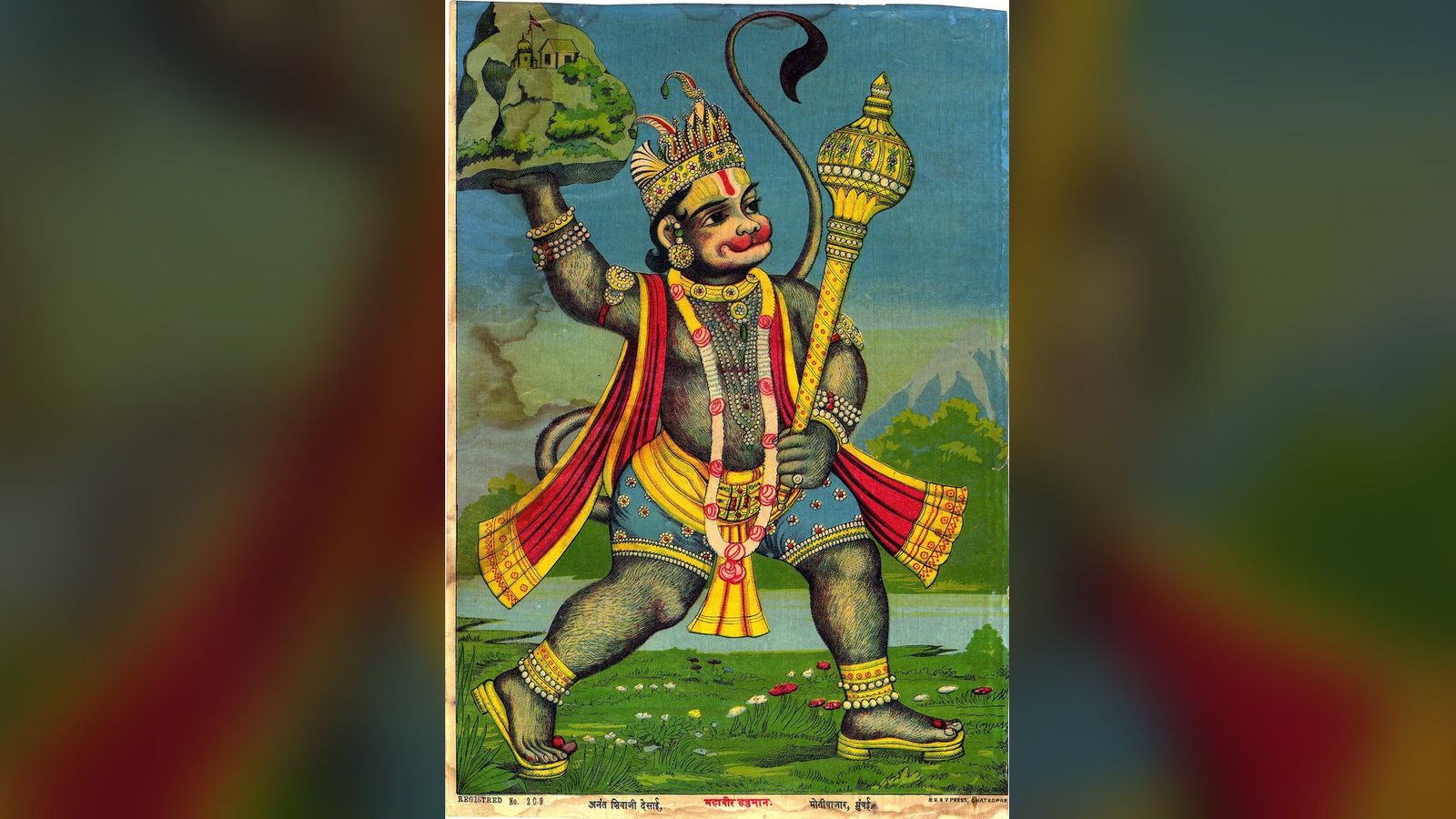
Updated: 14 November 2026
Quick answer: In Valmiki's Ramayana, Hanuman is the wind god Vayu's son and Sugriva's minister. He meets Rama, leaps the ocean to Lanka, finds Sita, burns Lanka's houses, and twice brings a herb mountain to heal the wounded. In the chapters we read, the sun-as-a-fruit tale is Jambavan's short retelling.
Contents
Key facts
| Fact | Detail | Source |
|---|---|---|
| Who is Hanuman? | A vanara (monkey-person), minister of Sugriva and son of the wind god Vayu, who finds Sita in Lanka | Valmiki Ramayana, Kishkindha Kanda 3, verses 21 to 23; Sundara Kanda 15 and 65 |
| Who are Hanuman's parents? | In Jambavan's account: Anjana, wife of the monkey Kesari, is his mother; he is also the wind god Vayu's "lineal son" | Valmiki Ramayana, Kishkindha Kanda 66, verses 8, 17 to 19, 29 to 30 |
| The sun-as-a-fruit story | Jambavan's retelling: the boy flies at the sun as at a fruit and Indra strikes him with a thunderbolt | Valmiki Ramayana, Kishkindha Kanda 66, verses 21 to 24 |
| The boons he received | In Jambavan's account: Brahma makes him indestructible by any missile; Indra grants that he dies only by his own will | Valmiki Ramayana, Kishkindha Kanda 66, verses 27 to 29 |
| How did he meet Rama? | Sent by Sugriva, he went disguised as an ascetic; a translator's note says Rama's long praise of his speech (3.28 to 35) is said to be a later addition | Valmiki Ramayana, Kishkindha Kanda 3, verses 1 to 2, 28 to 35 |
| Where did the leap begin? | On the Mahendra mountain; he vowed to return with Sita or uproot Lanka | Valmiki Ramayana, Sundara Kanda 1, verses 11 to 15 and 39 to 42 |
| Obstacles on the sea crossing | Mainaka offers rest, Surasa tests him, and Simhika is killed | Valmiki Ramayana, Sundara Kanda 1, verses 91 to 196 |
| How did he find Sita? | In the Ashoka garden, among rakshasa women; he showed her Rama's ring | Valmiki Ramayana, Sundara Kanda 15, verses 18 and 26; 36, verses 2 to 3 |
| How did Lanka burn? | Ravana ordered his tail burnt; the flame did not hurt him and he burnt the houses, leaving Vibhishana's | Valmiki Ramayana, Sundara Kanda 53, verses 2 to 8; 54, verses 11 to 16 |
| The herb mountain, first account | After a Brahma missile, Hanuman uproots a herb mountain; its fragrance heals Rama, Lakshmana and the monkeys | Valmiki Ramayana, Yuddha Kanda 74, verses 29 to 34, 64 to 77 |
| The herb mountain, second account | Lakshmana is struck by Ravana's spear; Hanuman brings a peak of Mount Oushadhi (Mahodaya) and Sushena heals him | Valmiki Ramayana, Yuddha Kanda 101, verses 1, 31 to 46 |
Who is Hanuman in the Valmiki Ramayana?
Hanuman is a vanara, a monkey-person, who serves the monkey king Sugriva and is the son of Vayu, the wind god; in Valmiki's Ramayana he finds Sita in Lanka and brings word of her to Rama. Sita is Rama's wife, and Lanka is the island city of Ravana, who carried her off.
When he meets Rama he says: "by name I am Hanuma, another Vanara", and "know me as a monkey and his minister, the son of Air-god" (Kishkindha Kanda, chapter 3, verses 21 to 23). The valmikiramayan.net translation we read spells his name Hanuma and calls Vayu the Air-god.
How was Hanuman born in the Ramayana?
In Valmiki's Ramayana, Hanuman is born to Anjana, the wife of the monkey Kesari, after the wind god Vayu tells her she will have a valiant son; the account is spoken by the bear king Jambavan in Kishkindha Kanda, chapter 66.
Jambavan, "the king of bears" (66.38), says Anjana "is the wife of Kesari, the monkey" (66.8) and was born again on earth as a monkey "owing to a curse" (66.9). Vayu embraces her unseen; she asks "who wishes to despoil my vow of one-man-one-wife" (66.16).
Jambavan calls Hanuman "Kesari's son through his wife" and "the lineal son of Air-god" (66.29 to 30); the translator's note says he is counted as both the wife's son of Kesari (kshetraja) and the direct son of the wind god (aurasa). The note adds that the direct-son sense is a secondary one, used to give him the wind god's qualities.
Read free: Kadarpaalam. Rama's vanaras build the bridge to Lanka, and the envy of one hard-working vanara halts the work. Read Episode 1 free →
Is the Hanuman sun-fruit story in the Ramayana?
The story of the boy Hanuman reaching for the sun as if it were a fruit is in Valmiki's Ramayana; in the chapters we read it is Jambavan's brief retelling, in Kishkindha Kanda 66.21 to 29.
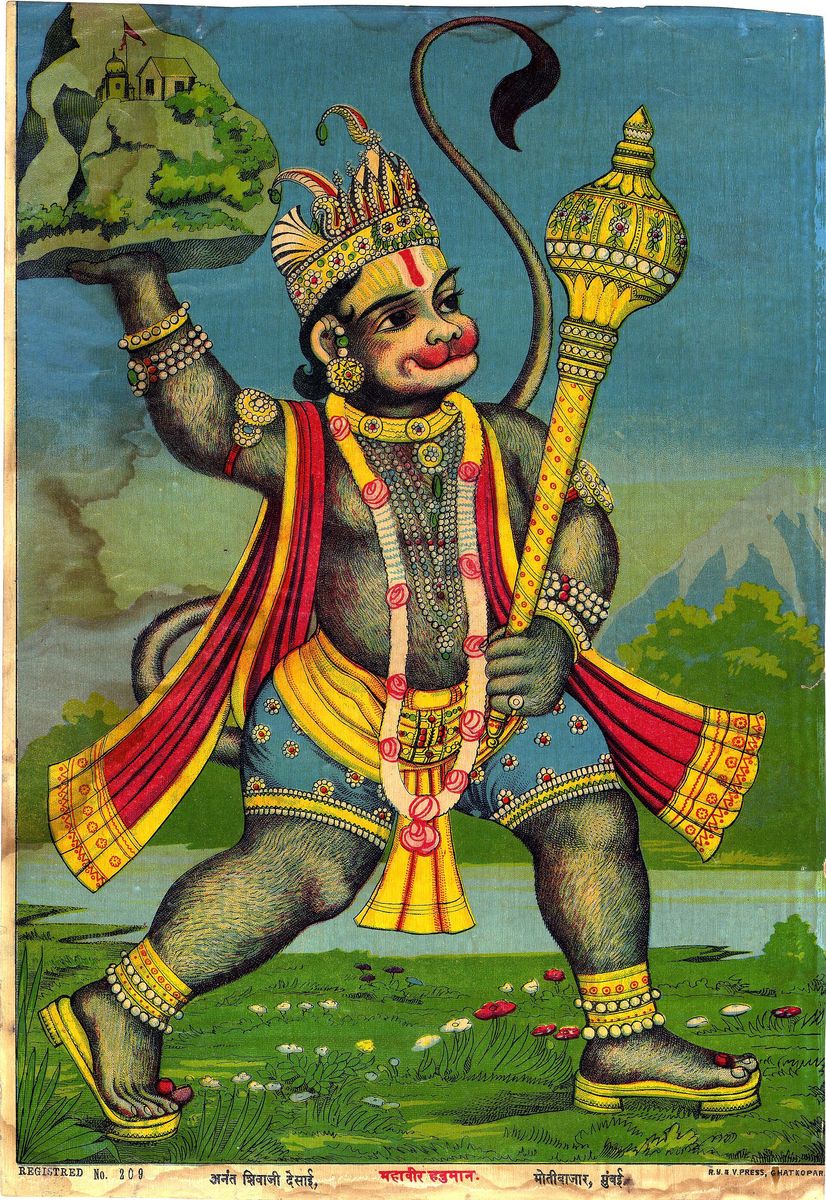
The sun (66.21 to 24): as a boy he sees the just risen sun, deems it "just ripen reddish fruit" and flies up "three hundred yojana-s" (a yojana is an old Indian measure of distance). Indra "catapulted his Thunderbolt at you", and "your left cheekbone, zygomatic arch, is broken"; the verse links his name Hanumaan to this.
The wind stops (66.25 to 26): Vayu "has not physically circulated throughout the triad of worlds".
The boons (66.27 to 29): Brahma, the creator, gives him "indestructibility by any missile", and Indra gives a boon that "your death occurs only by your own volition".
The verses of chapter 66 name no Shiva, Agni or Varuna. Wikipedia's "Childhood" section credits Valmiki's Ramayana with the tale and adds that Shiva revived him, yet its "Names and etymology" section calls it "a Puranic tale wherein infant Hanuman mistakes the Sun for a fruit". The Shiva detail is not in Kishkindha 66, and we did not trace its source.
How did Hanuman meet Rama?
Hanuman meets Rama in Kishkindha Kanda, chapter 3, when Sugriva sends him to find out who the two armed strangers are; Hanuman goes disguised as an ascetic.
The translation says that "Casting off his monkey's semblance Air-god's son Hanuma attained the persona of an ascetic" (3.2). Hanuman says Sugriva "is expelled by his brother Vali" (3.20) and wants their friendship (3.22).
A caution: Rama's longer praise of Hanuman's speech (3.28 to 35), including "not a single word has gone amiss of verbiage", is, the translator writes, "said to be crafted later"; the "Baroda edition ends at verse 4-3-27".
Why did Hanuman leap across the ocean to Lanka?
Hanuman leaps to Lanka to search for Sita, whom Ravana had taken away, and he sets out from the Mahendra mountain in Sundara Kanda, chapter 1, after Jambavan reminds him of his strength in Kishkindha Kanda 66.
Jambavan asks "why then is your unreadiness in this task of leaping ocean" (66.7). In Sundara Kanda 1 Hanuman "pressed the mountain with his feet and hands" (1.11); the translation names it the "Mahendra mountain" (1.15). He vows: "I will, in all events, return successfully along with Seetha or I will get Lanka along with Ravana after uprooting it" (1.39 to 42).
What obstacles did Hanuman meet on the way to Lanka?
On the sea crossing in Sundara Kanda chapter 1, Hanuman meets three obstacles: the mountain Mainaka, who offers him rest; Surasa, who tests him; and the demoness Simhika, who tries to seize him.
Mainaka (1.91 to 133): at the ocean's request the mountain rises from the water so Hanuman can rest. Hanuman says he cannot stop in the middle of his duty (1.132), and "touched the mountain with His hand, entered the sky and flew on with a smile" (1.133).
Surasa (1.145 to 171): the gods ask her to test him. She says "You have been given by Devas as my food" (1.151). He says he is on Rama's errand (1.153 to 156), but she insists (1.157 to 158). He shrinks until he "became the size of a thumb" (1.167), enters her mouth, comes out, and says "Your boon also came true" (1.169).
Simhika (1.182 to 196): she "attracted His shadow" (1.184); Hanuman "contracted His body and fell into her opened mouth" (1.192), and she is "killed by Hanuma" (1.196).
He then sees trees "at the end of his journey of hundred yojanas" (1.200) and, once on the shore, sees "the City of Lanka" (1.210). A translator's comment says the yojana "does not seem to be a standard even within India" (1.76).
How did Hanuman find Sita in Lanka?
Hanuman finds Sita in Ravana's Ashoka garden, guarded by rakshasa women, and gives her Rama's ring to win her confidence (Sundara Kanda, chapters 15 to 36). The rakshasas are the demon people of Ravana.
Hanuman sees a woman "surrounded by rakshasa women" and "thought that this is indeed Seetha on logical grounds" (15.18 and 15.26). She "suspected him as Ravana" in disguise (34.9). In chapter 36 he says "I am a monkey and a messenger of the wise Rama", shows the ring, "marked with Rama's name", and says he brought it "for the purpose of gaining your confidence" (36.2 to 3).
He offers to carry her back: "Ascend my back. I shall take you to Rama" (37.19). Sita declines, giving her own reasons, among them "Honouring the devotion to my husband" (37.60). The translator's introduction to chapter 65 says "Hanuma appraises Rama of Seetha's presence".
How did Hanuman burn Lanka?
Ravana orders Hanuman's tail set on fire, and Hanuman, finding that the flame does not hurt him, uses it to burn the houses of Lanka (Sundara Kanda, chapters 53 to 55).
After Vibhishana speaks, Ravana says "killing of an envoy is forbidden" but adds "a tail is possibly a beloved ornament for the monkeys" (53.2 to 3). The demons "sprinkled oil and set out fire on that tail" (53.8). Hanuman reasons: "The fire does not burn me, due to kindness of Seetha, powerfulness of Rama" (53.38).
He first asks what more he can do to grieve the demons, and decides that only the fort remains to be destroyed, which would make Rama's coming battle easier (54.2 to 4). He then reflects "It is justified to satisfy this blazing flame on my tail" (54.5) and passes from house to house, "Leaving the house of Vibhishana" (54.11 to 16). He then fears Sita has burnt too (55.8), until he hears heavenly bards say the city burnt "but Seetha alone was not burnt" (55.32), and goes back to her (56.1).
What is the Sanjeevani mountain story?
The Sanjeevani story is told twice in Valmiki's Ramayana, in Yuddha Kanda chapter 74 and again in chapter 101; in both, Hanuman flies to a herb mountain to heal the wounded in Lanka.
Chapter 74. The missiles of Indrajit, among them one "presided over by Brahma the creator", strike down Rama, Lakshmana and the monkey army (74.3 to 4). Jambavan sends Hanuman to the Himalayas for the herbs, among them "Mrita Sanjivani (capable of restoring the dead to life)" (74.33). The herbs "disappeared from Hanuma's view" (74.64), so Hanuman seizes the mountain top and takes it into the sky (74.67 to 68). By inhaling the herbs' fragrance, Rama and Lakshmana "became healed of their wounds then and there" (74.73), and Hanuman "carried away that mountain of herbs quickly back to the mountains of Himalayas" (74.77).
Chapter 101. Lakshmana is "struck down in battle with a spear by the mighty Ravana" (101.1). The monkey physician Sushena says Lakshmana is still alive (101.25 to 29) and sends Hanuman to the mountain called "Oushadhi (Mahodaya)" for four herbs, including "Samjivakarani" (101.31). Hanuman "could not identify those precious herbs" (101.34) and brings the whole peak (101.42); Sushena "administered it through Lakshmana's nose" and Lakshmana rises "rid as he was of the spear and his pain" (101.45 to 46).
These are two separate episodes, with different wounded. The mountain appears to be the same one (that reading is ours): chapter 74 calls it a "herbal mountain" (74.31), and in 101.31 Sushena sends Hanuman to Oushadhi (Mahodaya), "which was already described to you previously by Jambavan"; the chapter 101 introduction writes "Mount Mahodara". We found no note in either chapter that one account is a later addition.
What is Hanuman called in Tamil, and when is his festival?
In Tamil, Wikipedia lists the forms "Anuman (Tamil)" and "Anjaneyar (Tamil)" for Hanuman, and says that in parts of Tamil Nadu his birthday, Hanuman Jayanti, is kept in the month of Margali, December to January; in much of India it falls in Chaitra, March to April.
Is there a Siva Comics story linked to Hanuman's journey?
The Siva Comics series Kadarpaalam tells an untold episode from the building of Rama's bridge across the sea, set after Rama learns that Sita is held in Lanka; in Valmiki's Ramayana it is Hanuman who tells Rama where she is (Sundara Kanda 65), but the series page does not name Hanuman, and that link is ours.
The series page says: "Having learned that Sita was held in Lanka, Rama planned his march". Rama "marveled at a little squirrel toiling on the bridge and stroked its back in acknowledgement". Read Kadarpaalam today; Episode 1 is free.
Common questions
What is the Hanuman story in the Ramayana?
In Valmiki's Ramayana, Hanuman, a vanara and minister of Sugriva, leaps across the ocean to Lanka, finds Sita and burns Lanka's houses. In the war he fetches herb mountains to heal the wounded.
Who are Hanuman's parents in the Ramayana?
In Jambavan's account in Kishkindha Kanda 66, Hanuman is the son of Anjana, wife of the monkey Kesari, and is also the lineal son of the wind god Vayu, who told her she would have a valiant son.
Is the Hanuman sun-fruit story in Valmiki's Ramayana?
The sun-fruit story is in Kishkindha Kanda 66.21 to 24, told briefly by Jambavan. Hanuman flies at the sun as if at a fruit, and Indra strikes him with a thunderbolt. Details such as Shiva reviving him are not in that chapter.
How did Hanuman cross the ocean to Lanka?
He flew from the Mahendra mountain in Sundara Kanda chapter 1, meeting Mainaka, Surasa and Simhika on the way. The text speaks of a journey of a hundred yojanas, an old measure whose length a translator's comment says is not standard.
How did Hanuman find Sita?
He found her in Ravana's Ashoka garden in Lanka, among rakshasa women (Sundara Kanda 15.18). She suspected him of being Ravana in disguise (34.9); in chapter 36 he gave her Rama's ring (36.2 to 3).
Why did Hanuman burn Lanka?
In Sundara Kanda 54.2 to 4, Hanuman reasons that he has wrecked the garden and killed demons, and that destroying Lanka's fort would make Rama's coming battle easier. Ravana had ordered his tail set on fire as punishment (53.3); the flame did not hurt him, so he fed it to the city's houses (54.5), leaving Vibhishana's.
What is the Sanjeevani mountain story?
Valmiki tells it twice. In Yuddha Kanda 74 Hanuman uproots a herb mountain and its fragrance heals Rama, Lakshmana and the monkeys. In chapter 101 he brings a mountain peak to heal Lakshmana, struck by Ravana's spear.
Why is Hanuman called Hanuman?
In Jambavan's account in Kishkindha Kanda 66.24, the boy's left cheekbone breaks when he falls on a mountaintop after Indra's thunderbolt, "from thereupon your name-phrase is indeed averred as Hanumaan". The translator's word note glosses hanu as cheekbone and Hanuman as "one who has" it.
What is Hanuman called in Tamil?
Wikipedia lists "Anuman (Tamil)" and "Anjaneyar (Tamil)" as Tamil forms of the name. These come from Wikipedia's page, not from Valmiki's text.
Is there a Siva Comics story linked to Hanuman's journey?
Kadarpaalam, which tells an untold episode from the building of Rama's bridge, set after Rama learns that Sita is held in Lanka. Its series page does not name Hanuman; the link is ours. Episode 1 is free to read.
In the comic
Kadarpaalam tells an untold episode: Rama marveled at a little squirrel toiling on the bridge and stroked its back, and the envy this stirred in one hard-laboring vanara brought the work to a halt. Read Kadarpaalam, Episode 1 →
Sources
Valmiki Ramayana, Kishkindha Kanda, Sarga 3, valmikiramayan.net (Sanskrit text with English translation): Hanuman meets Rama; the translator's note that verses 28 to 35 are said to be a later addition
Valmiki Ramayana, Kishkindha Kanda, Sarga 66, valmikiramayan.net (Sanskrit text with English translation): Jambavan's account of Hanuman's birth, the sun-fruit story and the boons; the translator's notes
Valmiki Ramayana, Sundara Kanda, Sarga 1, valmikiramayan.net (Sanskrit text with English translation): the leap from the Mahendra mountain, Mainaka, Surasa, Simhika and the sight of Lanka
Valmiki Ramayana, Sundara Kanda, Sarga 15, valmikiramayan.net (Sanskrit text with English translation): Hanuman sees Sita in the Ashoka garden
Valmiki Ramayana, Sundara Kanda, Sarga 34, valmikiramayan.net (Sanskrit text with English translation): Sita suspects Hanuman of being Ravana in disguise
Valmiki Ramayana, Sundara Kanda, Sarga 36, valmikiramayan.net (Sanskrit text with English translation): Hanuman gives Sita the ring
Valmiki Ramayana, Sundara Kanda, Sarga 37, valmikiramayan.net (Sanskrit text with English translation): Hanuman offers to carry Sita; she declines
Valmiki Ramayana, Sundara Kanda, Sarga 53, valmikiramayan.net (Sanskrit text with English translation): Ravana orders the tail burnt; Sita prays to the fire god
Valmiki Ramayana, Sundara Kanda, Sarga 54, valmikiramayan.net (Sanskrit text with English translation): Hanuman burns the houses of Lanka
Valmiki Ramayana, Sundara Kanda, Sarga 55, valmikiramayan.net (Sanskrit text with English translation): Hanuman fears for Sita and hears she was not burnt
Valmiki Ramayana, Sundara Kanda, Sarga 56, valmikiramayan.net (Sanskrit text with English translation): Hanuman returns to Sita before leaving Lanka
Valmiki Ramayana, Sundara Kanda, Sarga 65, valmikiramayan.net (Sanskrit text with English translation): Hanuman tells Rama where Sita is
Valmiki Ramayana, Yuddha Kanda, Sarga 74, valmikiramayan.net (Sanskrit text with English translation): the Brahma missile and the first herb mountain
Valmiki Ramayana, Yuddha Kanda, Sarga 101, valmikiramayan.net (Sanskrit text with English translation): Lakshmana struck by a spear and the second herb mountain
Hanuman, Wikipedia: Tamil forms of the name, Hanuman Jayanti in Margali, and how its Childhood section differs from the Valmiki chapter
Kadarpaalam, sivacomics.com: the comic's story and creator, read 9 November 2026
Cite this page: Ramakrishnan S. "Hanuman Story: Birth, the Leap and Sanjeevani." Siva Comics, 14 November 2026. https://www.sivacomics.com/insider/hanuman-story
You just read the story. Now read the comics. Episode 1 of every series is free. A free account unlocks the rest and keeps your place. Start reading free → · Browse all series
Read the comics
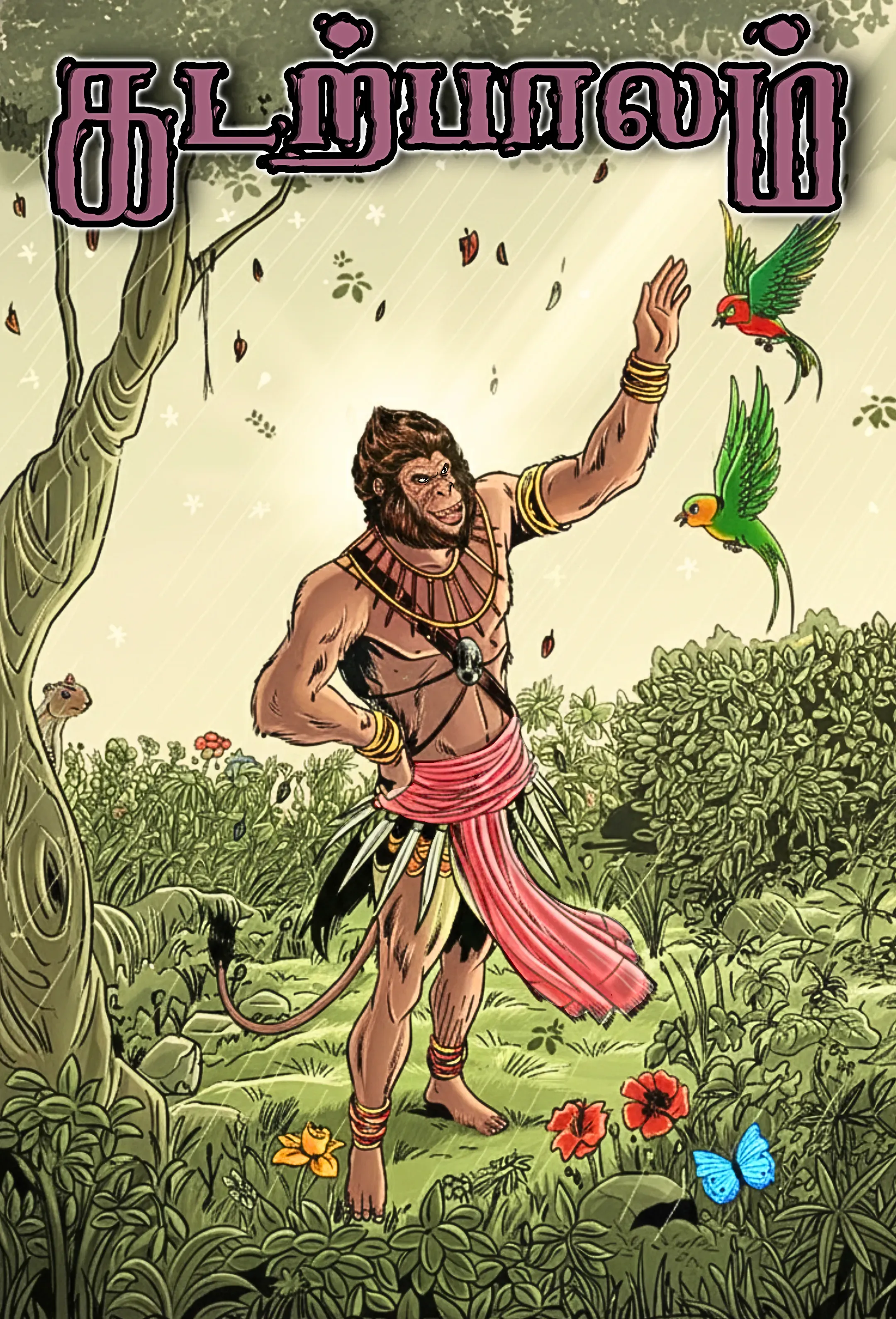
Kadarpaalam
Having learned that Sita was held in Lanka, Rama planned his march and, with the vanara army's help, ordered a bridge built across the sea. He marveled at a little squirrel toiling on the bridge and stroked its back in acknowledgement — and the envy this stirred in one hard-laboring vanara brought the work to a halt. That untold episode is Kadarpaalam.
Kabadapuram
When the doors of the Kumari Amman temple are sealed shut, a man trapped inside escapes with the help of a talking severed head. Crossing the dried-up sea, he is stunned by unbelievable wonders and reaches Kabadapuram — the city the ocean once swallowed. There he witnesses the strange feats of a siddha and sees a man who looks just like himself. On the shore of Kabadapuram, crumbling under tidal waves and volcanic eruptions, that double flees with the woman he loves. Did those who escaped survive — or were they caught in the deluge?