

Vibhishana: Traitor or Righteous?
Ramakrishnan S · 23 November 2026 · 16 min read
Updated: 23 November 2026
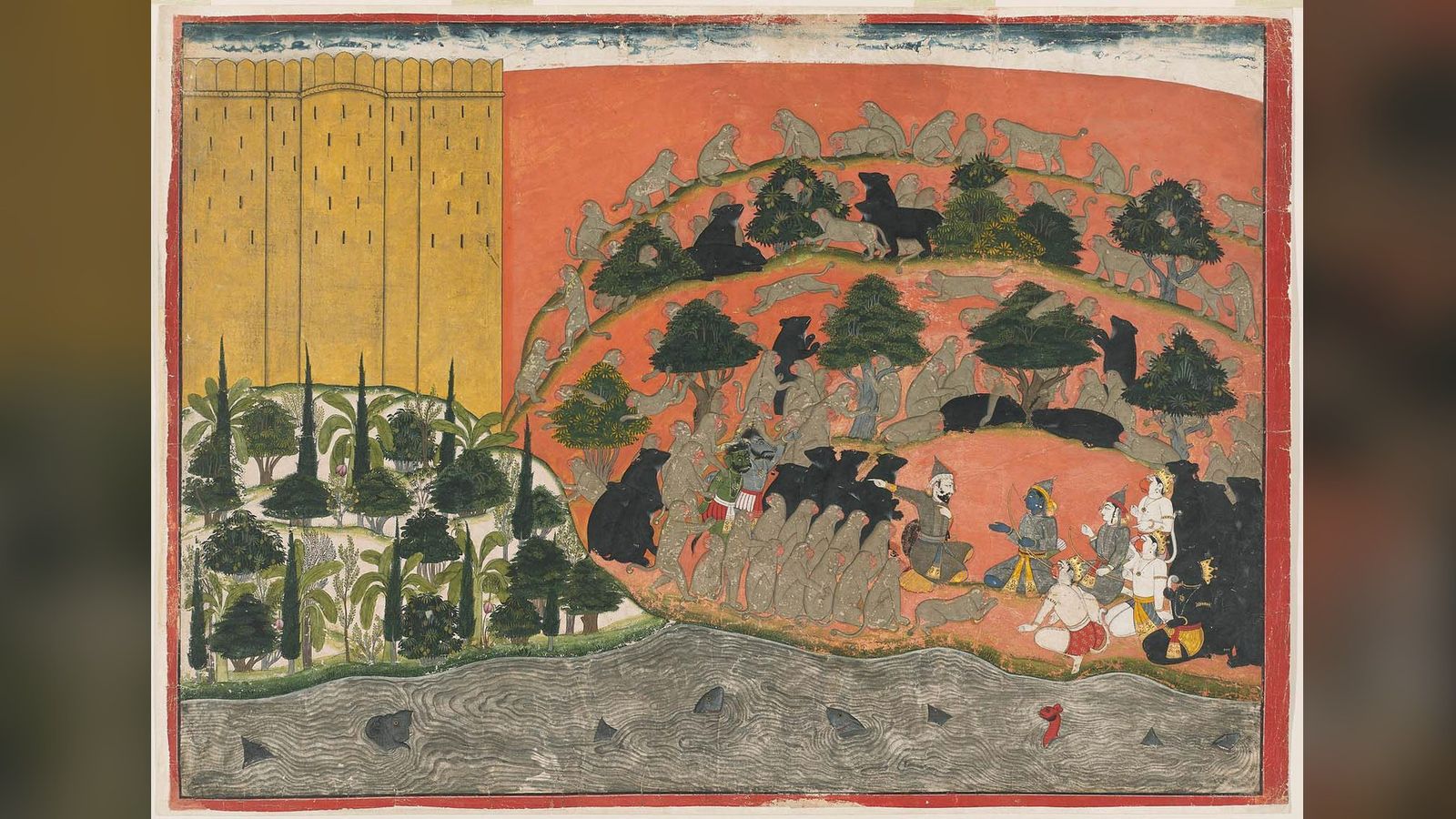
Quick answer: Vibhishana is Ravana's younger brother in the Ramayana. In Valmiki's text he urges Ravana to give Sita back, is sent away, and goes to Rama, who accepts him despite doubts and has him made king of Lanka. Characters accuse him of betrayal or defend him; the narrator speaks well of him.
Contents
Key facts
| Fact | Detail | Source |
|---|---|---|
| Who is Vibhishana? | Ravana's younger brother in Valmiki's Ramayana; he advises returning Sita and joins Rama | Yuddha Kanda 17, verse 12; 19, verse 4 |
| What did he say about killing Hanuman? | He argued an envoy must not be killed; Ravana agreed killing an envoy is forbidden and ordered Hanuman's tail burned instead | Sundara Kanda 52, verses 2 to 15; 53, verses 2 to 3 |
| What did he advise before the war? | Give Sita back to Rama, citing omens; Ravana refused and sent him away | Yuddha Kanda 10, verses 14 to 29; 14, verse 21 |
| Why did he leave Ravana? | After Ravana's harsh words and curse; he says he was humiliated and blames Ravana's vices | Yuddha Kanda 16, verses 1 to 26; 17, verse 16; 87, verse 26 |
| Who doubted him? | Sugriva, Angada, Jambavan, Sharabha and Mainda; Hanuman argued for him | Yuddha Kanda 17, verses 22 to 68; 18, verse 5 |
| Why did Rama accept him? | Rama said he does not desert one who comes as a friend and promised safety to a refuge-seeker | Yuddha Kanda 18, verses 3, 27 to 34 |
| What did he do in the war? | Revealed Indrajit's rite at Nikumbhila, fought Indrajit and Ravana; Lakshmana killed Indrajit | Yuddha Kanda 84, 85, 87, 90, 100 |
| When was he made king of Lanka? | The translation has two consecrations: at the seashore before the war and after Ravana's death | Yuddha Kanda 19, verses 25 to 26; 112, verses 9 to 16 |
| Did he perform Ravana's funeral? | He first said he owed Ravana no rites, then performed them after Rama spoke | Yuddha Kanda 111, verses 95 to 104 |
| Traitor or righteous? | Sugriva and Indrajit voice betrayal; Sugriva later calls him genuine. Hanuman and Rama accept him, citing his wish for the kingdom; Ravana admits his words came true | Yuddha Kanda 18.5, 18.37, 87.13, 17.67, 18.13, 68.21 |
| What is his boon in the Uttara Kanda? | In the Uttara Kanda, a book considered a later addition, Brahma grants him immortality after he asks for a righteous mind and the Brahma weapon | Uttara Kanda 10, Shastri translation (wisdomlib) |
Who is Vibhishana in the Ramayana?
Vibhishana is the younger brother of Ravana, the king of Lanka, in Valmiki's Ramayana. He is a rakshasa (the Sanskrit word for a demon) who urges Ravana to give back Sita, Rama's wife, and who goes over to Rama's side.
He gives the family tie in his own words: "I am his younger brother, known as Vibhishana." (Yuddha Kanda 17.12). A kanda is a book of the epic, and the Yuddha Kanda is the sixth, the Book of War. The chapter 10 introduction on the site we read calls him "Vibhishana, the half-brother of Ravana", and that chapter's translation also calls him a half-brother (verses 13 and 26). The Sanskrit word in those verses is bhrata, brother: the word-by-word gloss marks "half-" as an addition in brackets, and other chapters translate the same word as brother (for example 100.27). We say brother.
His birth is told in the Uttara Kanda, the seventh and last book. Wikipedia's Ramayana article says the first and last books are "considered to be later additions". In Hari Prasad Shastri's translation on wisdomlib, chapter 9 says "Kaikasi’s last child was named Bibishana".
What did Vibhishana say when Ravana wanted Hanuman killed?
When Ravana ordered the monkey messenger Hanuman killed, Vibhishana spoke against it, saying that sages do not allow an envoy to be killed. An envoy is a messenger sent by the other side.
In chapter 52 of the Sundara Kanda (the fifth book), Ravana is angry and "ordered for the killing" of Hanuman (verse 1). "Vibhishana did not agree to the killing of Hanuma" (verse 2; the translation spells it Hanuma). He says: "Sages say that messengers should not be killed at all places and at all times." (verse 13).
In chapter 53 Ravana says, "You have spoken well indeed that killing of an envoy is forbidden." (verse 2), and orders another punishment, the burning of Hanuman's tail (verse 3).
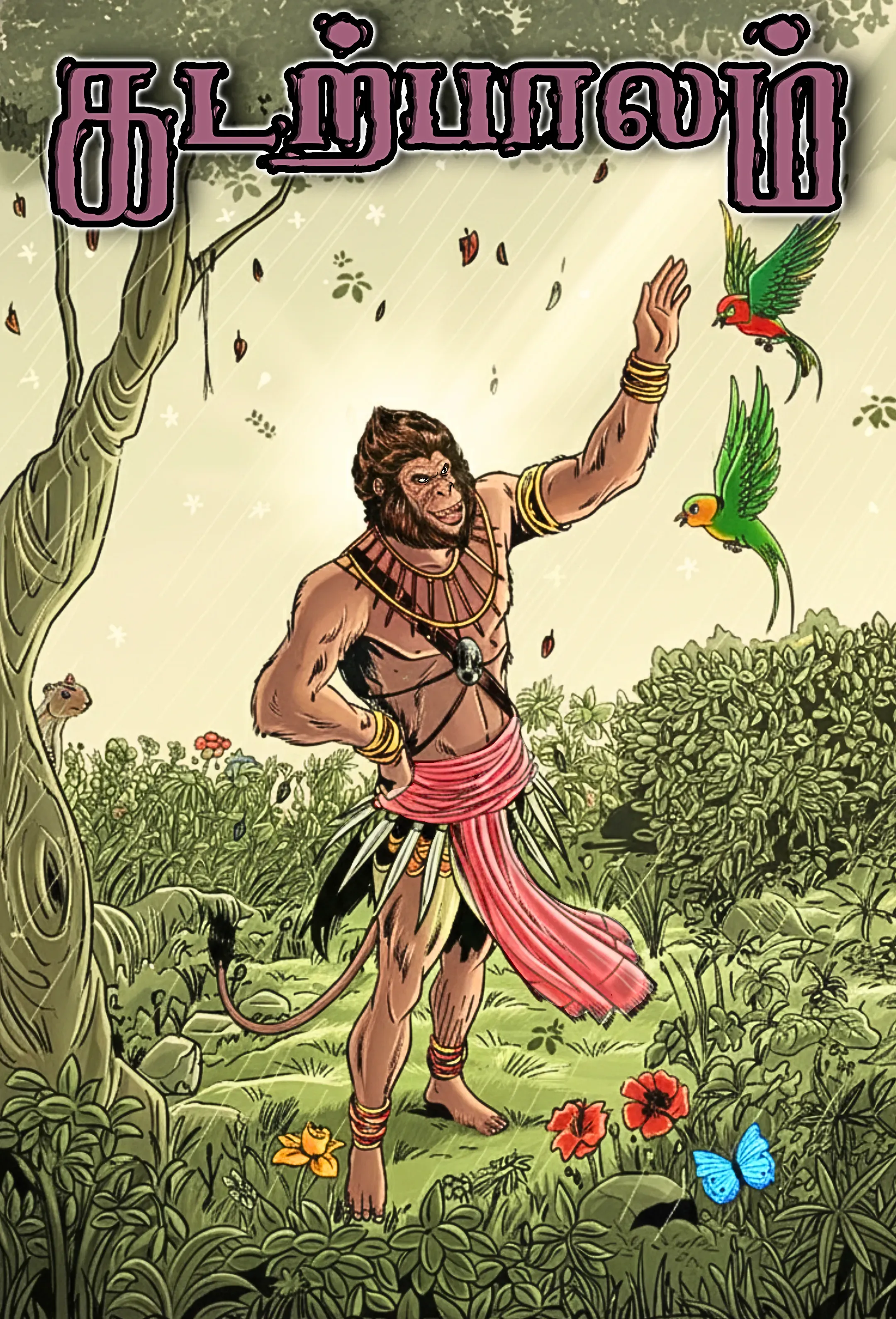
Read free: Kadarpaalam. Rama's vanaras build the bridge to Lanka, and the envy of one hard-working vanara halts the work. Read Episode 1 free →
What did Vibhishana advise Ravana before the war?
Vibhishana advised Ravana more than once to give Sita back to Rama: in the palace after he saw bad omens, and again in the assembly. An omen is a sign of coming trouble.
In chapter 10 of the Yuddha Kanda he tells Ravana, "We are seeing inauspicious omens, since Seetha arrived here." (verse 14). He proposes: "this atonement is appropriate that Seetha be given away to Rama" (verse 22). Ravana answers, "Rama cannot obtain Seetha by any means." (verse 28), and "sent away Vibhishana, who had spoken honestly" (verse 29).
In chapter 14 Vibhishana speaks to the assembly after "the growls of Kumbhakarna" (verse 1). In the same chapter Vibhishana says, "Let Sita be given back to Rama." (verse 21).
Why did Vibhishana leave Ravana?
In Valmiki's text Vibhishana leaves after Ravana answers his advice with harsh words and a curse; in his own accounts he gives the harsh words, the humiliation and Ravana's vices as his reasons.
In chapter 16 of the Yuddha Kanda the narrator says Ravana "spoke the following harsh words to Vibhishana" (verse 1). Ravana says, "One can stay together with an enemy or even with a furious snake, but one cannot stay together with an adversary yet avowing himself as a friend" (verse 2). He ends with "A curse upon you!" (verse 16).
Vibhishana "soared high into the sky, along with four other demons" (verse 17). He says, "Elder brother is like a father." and "But I cannot forbear these harsh words from you." (verse 19). He ends: "I am departing." (verse 26).
In other chapters he gives further reasons in his own words. To the monkeys he says he was "humiliated as a slave" (17.16). To Indrajit: "Because of these vices, Ravana, your father and my brother, has been abandoned by me." (87.26).
How did Rama receive Vibhishana?
Rama's own side doubted Vibhishana, but Rama accepted him because he had come asking for refuge (protection), and gave him a promise of safety.
In chapter 17 Vibhishana stops in the sky with four other demons. Sugriva, king of the monkeys, says, "He may be a spy of Ravana the king of demons." (verse 22). Angada says, "Vibhishana who came from an enemy is indeed to be doubted by all means." (verse 39). Hanuman says, "I am not seeing any bad intention at all in his talk." (verse 62).
In chapter 18 Rama says, "I do not desert anyone who arrives with a friendly appearance, even if he has a defect." (verse 3). Sugriva objects, "Whom will he not betray subsequently?" (verse 5). Rama cites verses of a sage called Kandu that someone "who is seeking a refuge should not be killed" (verse 27), and declares: "Let him either be Vibhishana or even Ravana himself; I have given an assurance of safety to him. Bring him here." (verse 34).
In chapter 19 he tells Rama, "Abandoning Lanka, friends and possessions, I place my kingdom, life and happiness at your disposal." (verse 5).
What did Vibhishana do in the war?
On Rama's side Vibhishana is an adviser who knows Lanka and a fighter: he describes Ravana's commanders, shows where Indrajit's ritual is held, and fights both Indrajit and Ravana.
In chapter 19 Rama asks for the strengths and weaknesses of the demons, and Vibhishana describes Ravana's boon from Brahma, his brother Kumbhakarna, the commander Prahasta and Indrajit (verses 7 to 13). He also says, "It is apt if prince Rama seeks ocean as his refuge" (verse 30).
When Rama faints on hearing that Indrajit has killed Sita (84.7), Vibhishana tells him, "Know that Seetha (who was seemingly killed by him) as illusory." (84.13), and that Indrajit will pour oblations (offerings) into the sacred fire at "a sanctuary by name Nikumbhila" (84.14). Rama sends Lakshmana with Vibhishana, "who knows all the conjuring tricks of Indrajit" (85.23). In chapter 90 Vibhishana "killed the horses of that evil-minded Indrajit with his mace" (verse 42), and Lakshmana's arrow ends Indrajit (verses 72 to 75).
In chapter 100, against Ravana, Vibhishana "killed, with his mace, the excellent horses of Ravana" (verse 17), and Ravana "hurled a spear looking like a blazing thunderbolt, on Vibhishana" (verse 19), and Lakshmana rescues him (verse 27).
What did Vibhishana do when Ravana died?
When Ravana lay dead, Vibhishana first said he owed him no funeral rites, then performed them after Rama spoke.
In chapter 111 Vibhishana says to Rama, "I am not obliged to perform the obsequies to him, who had abandoned the vow of virtue" (verse 95). Obsequies are funeral rites. Rama repeats, "Hostilities end with death." (verse 102), and the narrator says, "Vibhishana in haste began to do obsequies to Ravana, his dead brother." (verse 104). Chapters 109 and 111 both carry Rama's line about hostilities ending with death.
When did Rama make Vibhishana king of Lanka?
In the translation we read, Vibhishana is consecrated (made king by a ritual sprinkling of water) twice: at the seashore before the war, and after Ravana's death.
In chapter 19 Rama promises, "I will make you the king" after killing Ravana (verse 19). He then orders: "Quickly consecrate as a king of demons this greatly intelligent Vibhishana with that water, so that I am pleased." (verse 25). The narrator says, "Lakshmana consecrated Vibhishana as a king, as per the royal instructions, amidst the leaders of monkeys" (verse 26).
In chapter 112 Rama tells Lakshmana to consecrate Vibhishana, calling him "the one who has formerly done a service to us" (verse 9). Lakshmana "sprinkled him with sea-water from that pot" (verse 15).
Was Vibhishana a traitor or righteous?
Valmiki's text lets characters accuse and defend him, but the narrator's own words favour him: he is the one "who had spoken honestly" (10.29) and "who advocates justice" (16.17). In the chapters we read, nobody, narrator or character, uses the word traitor; the charge is one of betrayal, made by characters.
The charge. Indrajit says Vibhishana has "entered into the service of our enemy" (87.13). Sugriva asks, "Whom will he not betray subsequently?" (18.5). Sugriva later tells Rama, "My inmost spirit also feels Vibhishana to be a genuine person" (18.37).
The defence. Vibhishana says, "my nature is goodness" (87.19). Ravana himself says, "my pious brother was banished by me" (68.23) and that Vibhishana's words "have come true" (68.21).
The motive. Hanuman says Vibhishana "found merits in you and demerits in Ravana" (17.57) and came "with a desire to obtain the kingdom of demons", adding, "On consideration of this aspect alone, he is worthy of acceptance by us." (17.67). Rama also says "Vibhishana the demon is desirous of acquiring the kingdom" and gives it as a reason he "is acceptable" (18.13). Vibhishana says "Elder brother is like a father." (16.19), and in the end performs the rites.
That reading is ours: the text leans toward him but lets the charge be heard. It shows a man who warned, was sent away, and mourned his brother. Whether loyalty to a brother or refusing to share in a wrong comes first is left to the reader.
What do later traditions say about Vibhishana?
Later tradition counts Vibhishana among the eight chiranjivis and ties him to the Srirangam temple. Neither the list of eight nor the Srirangam story is in the Valmiki chapters we read, and our source for both is Wikipedia; the Uttara Kanda does have Brahma granting him immortality.
Wikipedia lists him among the eight chiranjivis, with reasons that include Brahma's boon, which has support in the Uttara Kanda (a later book, in Shastri's translation, chapter 10), where Brahma says, "I grant you immortality!" There Vibhishana asks for a mind fixed on righteousness and also, "Without being instructed, may I be able to use the Brahma Weapon."
Wikipedia also gives a regional legend of the Srirangam temple: Vibhishana was given the Sri Ranga vimana (a shrine for the image) at Rama's coronation and tried to carry it to Lanka, but on the banks of the Kaveri river "it could not be lifted". We have not opened the temple's own account.
Common questions
Who is Vibhishana in the Ramayana?
Vibhishana is Ravana's younger brother in Valmiki's Ramayana. He tells Ravana to give Sita back to Rama, is sent away, goes to Rama, and is later consecrated king of Lanka (Yuddha Kanda 10 to 19, 112).
Why did Vibhishana leave Ravana?
In Yuddha Kanda 16 Ravana answers his advice with harsh words and a curse, and Vibhishana says he cannot bear them. He also says he was humiliated (17.16) and that he abandoned Ravana because of Ravana's vices (87.26).
Was Vibhishana a traitor?
No character in the chapters we read uses the word traitor. Sugriva asks whom he will not betray (18.5) but later calls him genuine (18.37); Indrajit says he serves the enemy (87.13). Hanuman and Rama note his wish for the kingdom as a reason to accept him (17.67, 18.13), the narrator calls him one "who had spoken honestly" (10.29), and Ravana says his words came true (68.21). Our reading: the text leans toward him but lets the charge be heard.
What did Vibhishana advise Ravana?
He advised giving Sita back to Rama. In Yuddha Kanda 10 he cites bad omens and proposes returning Sita as atonement; in chapter 14 he repeats it in the assembly. In Sundara Kanda 52 he also argued against killing Hanuman.
How did Rama treat Vibhishana when he arrived?
Rama's counsellors doubted him, but Rama said he does not desert one who arrives as a friend, cited verses that a refuge-seeker should not be killed, and promised him safety (Yuddha Kanda 18.3, 18.27, 18.34).
What was Vibhishana's role in the war?
He described Ravana's commanders to Rama, told him Sita's apparent death was illusory, revealed where Indrajit's ritual was held, and fought Indrajit and Ravana. Lakshmana, not Vibhishana, killed Indrajit (Yuddha Kanda 19, 84 to 90, 100).
When was Vibhishana crowned king of Lanka?
The translation we read shows two consecrations: Rama has Lakshmana consecrate him at the seashore before the war (Yuddha Kanda 19.25 to 26), and again after Ravana's death (112.9 to 16). The pages carry no note on this.
Is Vibhishana immortal?
Tradition, as Wikipedia reports it, counts him among the eight chiranjivis. In the Uttara Kanda, the last book, which Wikipedia says is considered a later addition, Brahma says "I grant you immortality!" (chapter 10, Shastri translation). The Yuddha Kanda chapters we read do not say this.
Did Vibhishana really perform Ravana's funeral?
In the text we read, Vibhishana performs the funeral rites of Ravana. In Yuddha Kanda 111 he first says he owes Ravana no rites, calling him an enemy in the guise of a brother, and after Rama speaks he begins them (verses 95 to 104).
Does Kadarpaalam feature Vibhishana?
The Kadarpaalam series page does not name him. It describes Rama ordering a bridge built across the sea. The link to this article is ours: in Yuddha Kanda 19 Vibhishana advises seeking the ocean's help to reach Lanka.
In the comic
The Kadarpaalam series page says Rama "ordered a bridge built across the sea" and "marveled at a little squirrel toiling on the bridge and stroked its back in acknowledgement", and that "the envy this stirred in one hard-laboring vanara brought the work to a halt". The page does not mention Vibhishana; the link to this article is ours. Read Kadarpaalam, Episode 1 →
Sources
Valmiki Ramayana, Sundara Kanda, Sarga 52, valmikiramayan.net (Sanskrit text with English translation): Vibhishana argues against killing Hanuman, the envoy
Valmiki Ramayana, Sundara Kanda, Sarga 53, valmikiramayan.net (Sanskrit text with English translation): Ravana accepts that killing an envoy is forbidden and orders the tail burned
Valmiki Ramayana, Yuddha Kanda, Sarga 10, valmikiramayan.net (Sanskrit text with English translation): the omens and Vibhishana's counsel; Ravana sends him away; the half-brother note
Valmiki Ramayana, Yuddha Kanda, Sarga 14, valmikiramayan.net (Sanskrit text with English translation): Vibhishana in the assembly
Valmiki Ramayana, Yuddha Kanda, Sarga 16, valmikiramayan.net (Sanskrit text with English translation): Ravana's harsh words and Vibhishana's departure
Valmiki Ramayana, Yuddha Kanda, Sarga 17, valmikiramayan.net (Sanskrit text with English translation): Vibhishana arrives; the doubts and Hanuman's defence
Valmiki Ramayana, Yuddha Kanda, Sarga 18, valmikiramayan.net (Sanskrit text with English translation): Rama accepts Vibhishana
Valmiki Ramayana, Yuddha Kanda, Sarga 19, valmikiramayan.net (Sanskrit text with English translation): Vibhishana's account of Lanka, the first consecration, the ocean advice
Valmiki Ramayana, Yuddha Kanda, Sarga 68, valmikiramayan.net (Sanskrit text with English translation): Ravana admits Vibhishana's words came true
Valmiki Ramayana, Yuddha Kanda, Sarga 84, valmikiramayan.net (Sanskrit text with English translation): Vibhishana on the illusory Sita and Nikumbhila
Valmiki Ramayana, Yuddha Kanda, Sarga 85, valmikiramayan.net (Sanskrit text with English translation): Rama sends Lakshmana with Vibhishana
Valmiki Ramayana, Yuddha Kanda, Sarga 87, valmikiramayan.net (Sanskrit text with English translation): Indrajit's charge and Vibhishana's reply
Valmiki Ramayana, Yuddha Kanda, Sarga 90, valmikiramayan.net (Sanskrit text with English translation): the fight in which Indrajit dies
Valmiki Ramayana, Yuddha Kanda, Sarga 100, valmikiramayan.net (Sanskrit text with English translation): Vibhishana and Ravana's spear
Valmiki Ramayana, Yuddha Kanda, Sarga 109, valmikiramayan.net (Sanskrit text with English translation): Vibhishana's lament and Rama's reply
Valmiki Ramayana, Yuddha Kanda, Sarga 111, valmikiramayan.net (Sanskrit text with English translation): Vibhishana and the funeral rites
Valmiki Ramayana, Yuddha Kanda, Sarga 112, valmikiramayan.net (Sanskrit text with English translation): the consecration after Ravana's death
Valmiki Ramayana, Yuddha Kanda, Sarga 113, valmikiramayan.net (Sanskrit text with English translation): Hanuman tells Sita Lanka is under Vibhishana
Valmiki Ramayana, Yuddha Kanda, Sarga 114, valmikiramayan.net (Sanskrit text with English translation): Vibhishana brings Sita to Rama
Ramayana of Valmiki, Uttara Kanda, Chapter 9 (Shastri translation), wisdomlib.org: Vibhishana as Kaikasi's last child; a later book
Ramayana of Valmiki, Uttara Kanda, Chapter 10 (Shastri translation), wisdomlib.org: Vibhishana's boon request and Brahma's grant; a later book
Ramayana, Wikipedia: the statement that the first and last books are considered later additions
Vibhishana, Wikipedia: the chiranjivi tradition and the Srirangam legend (tradition, not the Valmiki text)
Kadarpaalam, sivacomics.com: the comic's story, read 9 November 2026
Cite this page: Ramakrishnan S. "Vibhishana: Traitor or Righteous?." Siva Comics, 23 November 2026. https://www.sivacomics.com/insider/vibhishana
You just read the story. Now read the comics. Episode 1 of every series is free. A free account unlocks the rest and keeps your place. Start reading free → · Browse all series
Read the comics
Kadarpaalam
Having learned that Sita was held in Lanka, Rama planned his march and, with the vanara army's help, ordered a bridge built across the sea. He marveled at a little squirrel toiling on the bridge and stroked its back in acknowledgement — and the envy this stirred in one hard-laboring vanara brought the work to a halt. That untold episode is Kadarpaalam.
Kabadapuram
When the doors of the Kumari Amman temple are sealed shut, a man trapped inside escapes with the help of a talking severed head. Crossing the dried-up sea, he is stunned by unbelievable wonders and reaches Kabadapuram — the city the ocean once swallowed. There he witnesses the strange feats of a siddha and sees a man who looks just like himself. On the shore of Kabadapuram, crumbling under tidal waves and volcanic eruptions, that double flees with the woman he loves. Did those who escaped survive — or were they caught in the deluge?